
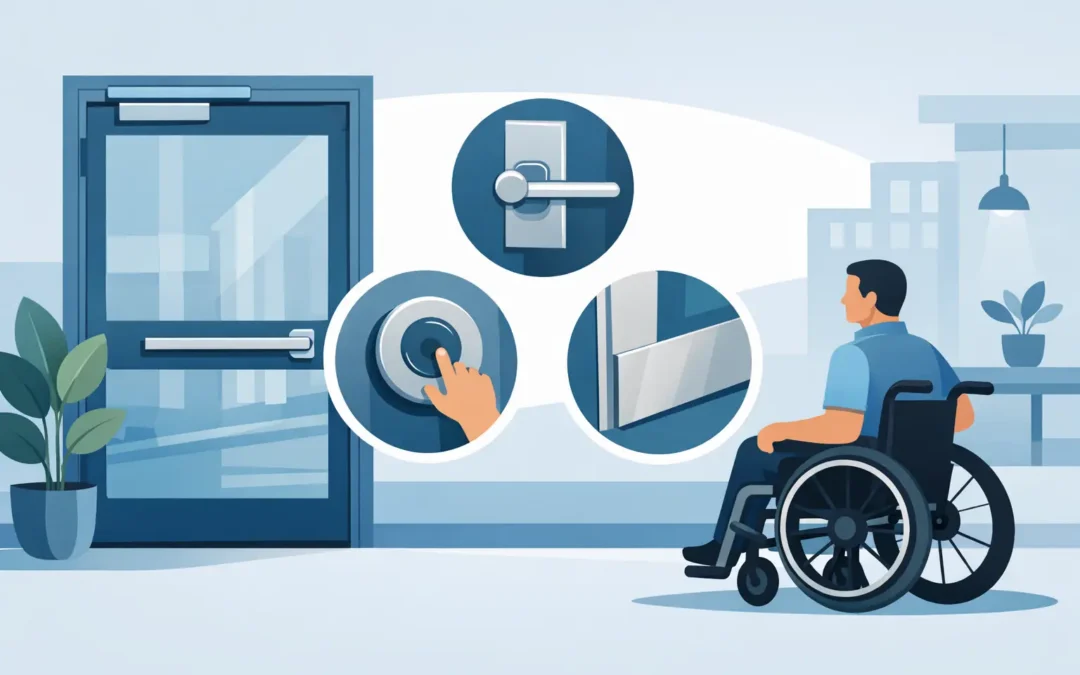
A door can have the right frame, a durable closer, and a quality lock, yet still create a barrier for someone entering or leaving a building. ADA compliant door hardware addresses the details that determine whether people can use a door independently: how high the handle sits, how much force the door requires, whether a lock can be operated with one hand, and whether the closing speed allows enough time to pass through.
For schools, healthcare facilities, hotels, retail spaces, offices, and public buildings across Northern Illinois and Southern Wisconsin, accessible hardware is not an afterthought. It should be part of the door specification from the beginning. The right combination improves access, supports code compliance, reduces service calls, and gives every visitor a safer, more dependable entrance.
What Makes Door Hardware ADA Compliant?
The Americans with Disabilities Act sets accessibility requirements for many public accommodations and commercial facilities. Local building codes, fire codes, and project specifications may add further requirements, so the final decision should always account for the authority having jurisdiction and the door’s intended use.
At the hardware level, the primary concern is simple: a person should be able to approach, open, pass through, and secure the door without excessive strength or complicated hand movements. Hardware must generally be operable with one hand and cannot require tight grasping, pinching, or twisting of the wrist.
That is why lever handles are common on accessible openings. A lever can be pushed down with a closed fist, elbow, or limited hand strength, while a round knob usually requires a twisting motion. Push-pull hardware, paddle latches, and properly specified exit devices can also meet accessibility needs when installed at the correct height and paired with a door that operates within allowable force limits.
Accessible operable parts are generally mounted between 34 and 48 inches above the finished floor. That range applies to handles, locks, latches, and similar controls. The measurement sounds straightforward, but finished flooring changes, thresholds, door sweeps, and field adjustments can affect the final result. Accurate installation matters as much as selecting a compliant product.
ADA Compliant Door Hardware Starts With the Whole Opening
A compliant lever alone does not make an opening accessible. Door hardware works as a system with the door, frame, hinges, closer, threshold, weatherstripping, and surrounding clearances.
Consider a commercial aluminum storefront entry with a heavy glass door. A lever may meet the mounting and operability requirements, but a closer set too aggressively can make the door difficult to pull open. The same issue appears with hollow metal doors in schools, steel entry doors at service areas, and fire-rated corridor doors in assisted living facilities. Door weight, gasket compression, hinge condition, air pressure, and closer adjustment all influence opening force.
For interior hinged doors, ADA standards generally limit opening force to 5 pounds, excluding the force required to retract the latch. Fire doors are treated differently because they must close and latch reliably for life safety. On fire-rated openings, the closing force must be the minimum necessary to close and latch the door. That creates a practical balance: a fire door cannot be adjusted so lightly that it fails its fire-protection function, but it should not be harder to operate than necessary.
Closing speed matters, too. A door closer should allow at least five seconds for the door to move from 90 degrees open to 12 degrees from the latch. A closer that slams or closes too quickly is difficult for people using walkers, wheelchairs, carts, or mobility aids. It can also damage hardware, loosen fasteners, and create unnecessary maintenance issues.
Thresholds and maneuvering clearance are not hardware components in the narrow sense, but they should be reviewed during every accessibility evaluation. A low-profile, code-appropriate threshold and adequate clear floor space can make a well-equipped opening work as intended. Without them, even the best lockset and closer will not solve the access problem.
Choosing the Right Lever, Lock, and Exit Device
The hardware selection depends on the opening’s purpose. An office suite, classroom, exterior entry, restroom, electrical room, and emergency exit all need different security and life-safety functions. Accessibility should be built into that function rather than added after the hardware schedule is complete.
For most swinging entry doors, a commercial-grade lever lock is the practical starting point. Look for a lever shape that is easy to press without snagging clothing or bags. Return-to-door levers are often specified in busy facilities because they reduce projection into the path of travel, but the best choice depends on the door location and applicable code requirements.
Deadbolts, privacy locks, and thumbturns should also be evaluated for one-hand operation. A small, stiff thumbturn may be difficult for someone with limited dexterity, even if it appears to be installed at the correct height. Oversized or accessible thumbturn designs can be a better fit for restrooms, patient rooms, and other occupied spaces.
Panic hardware and fire exit hardware require additional attention. On doors where panic devices are required, the touchpad or crossbar must be easy to actuate and located within the required reach range. The device must allow free egress without a key, special knowledge, or complicated operation. Electrified panic hardware, card access, delayed egress, and alarmed exits can be appropriate for controlled facilities, but these systems need careful coordination with fire and life-safety requirements.
Automatic operators are often a smart solution for high-traffic entrances, healthcare facilities, senior living communities, and locations where heavy doors are unavoidable. A low-energy operator can reduce opening-force concerns and make daily access easier. However, automatic operation does not eliminate the need for correct hardware, safe closing behavior, required signage, and dependable manual use during power interruptions.
Common Problems Found During Door Inspections
Most accessibility problems are not caused by a single dramatic mistake. They develop over time through repairs, tenant changes, weather exposure, and hardware substitutions.
A lever may be replaced with a knob after a break-in repair. A closer may be tightened to overcome wind pressure or a door that is dragging on worn hinges. New carpet or flooring may raise the finished floor and leave hardware outside the proper mounting range. A latch may become difficult to retract because the strike is misaligned. Each issue can turn an otherwise functional entrance into a frustrating one.
Facility managers should include accessible openings in routine door inspections. Check whether the door opens smoothly, latches securely, and closes at a controlled speed. Test the lever, lock, and exit device with one hand. Look for loose screws, damaged weather seals, sagging hinges, bent push pads, and signs that the latch is rubbing against the strike.
Exterior doors deserve special attention in winter. Ice, snow, moisture, and worn sweeps can interfere with thresholds and closing action. In Northern Illinois and Southern Wisconsin, seasonal conditions can quickly expose a marginal door adjustment. Prompt service keeps the entrance safer and helps prevent a minor hardware issue from becoming a failed closer, damaged frame, or locked-out customer.
When Replacement Is Better Than Adjustment
Adjustment is often the right first step. A qualified technician can align a strike, replace worn hinges, tune a closer, repair a panic device, or install an accessible lever without replacing the entire door. This approach can restore operation quickly and control costs.
Replacement makes more sense when the door is severely warped, the frame is damaged, the hardware preparation is incompatible with the needed function, or the opening has repeated performance issues. It may also be the better option during a renovation, occupancy change, or fire-door upgrade. Specifying the right hollow metal door, frame, closer, lock, exit device, and threshold together avoids piecemeal fixes that create new problems later.
A professional hardware review should consider security, fire rating, traffic level, weather exposure, keying, access control, and accessibility at the same time. The lowest-cost hardware is not always the least expensive choice if it wears out early, creates barriers, or requires frequent adjustment.
Get the Details Right Before the Door Is Installed
Accessibility is easier to achieve when it is planned before doors and hardware arrive on site. Review the hardware schedule, opening type, hand of door, fire rating, door width, approach clearances, and closer requirements before installation begins. For occupied buildings, inspect existing openings before ordering replacements so the new hardware solves the actual problem.
Barcol Door Company helps commercial customers coordinate doors, frames, hardware, installation, and repair from one experienced source. Whether the need is a single accessible lever replacement or a larger facility upgrade, getting the opening evaluated as a complete system can save time and prevent avoidable rework.
The best accessible door is not one that merely passes a checklist. It is one that opens predictably, latches securely, supports safe egress, and works without hesitation for every person who reaches for the handle.