
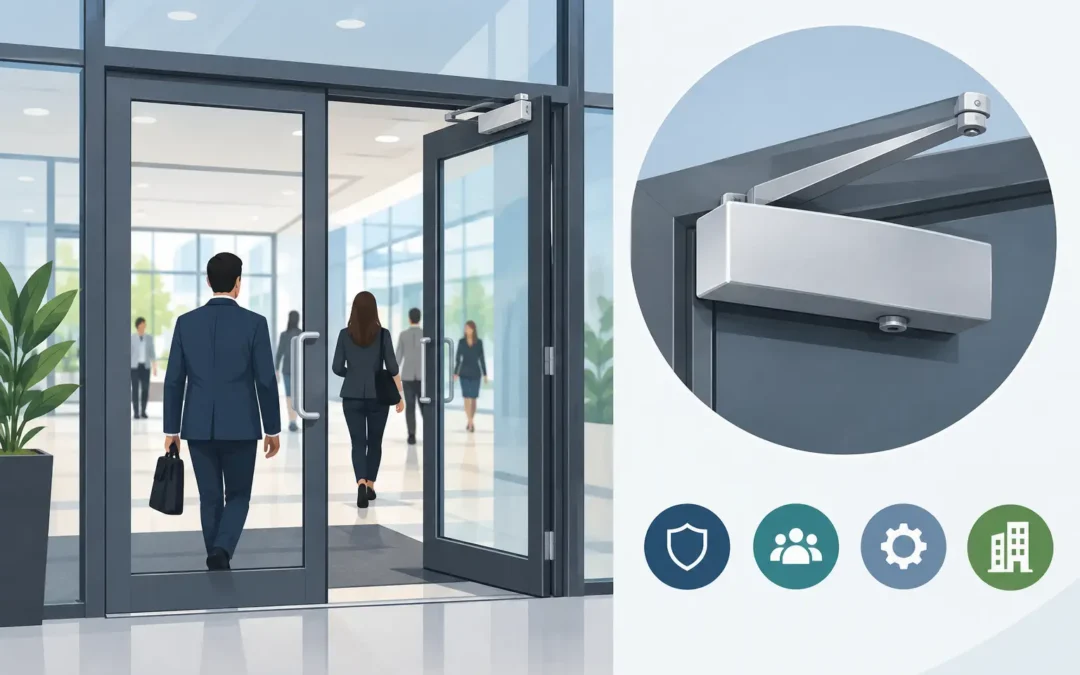
A door closer at a busy school entrance, medical office, apartment building, or retail store may cycle hundreds of times a day. Choosing the best door closers for high traffic is not about finding the strongest-looking unit on the shelf. It is about matching the closer to the door weight, opening conditions, traffic pattern, code requirements, and the building’s need for reliable service.
When a closer is undersized or poorly installed, the problems show up quickly: slamming doors, doors that do not latch, leaking hydraulic fluid, loose hardware, damaged frames, and frustrated occupants. A properly specified commercial closer provides controlled closing, dependable latching, and a safer entrance that keeps working under daily use.
What Makes a Door Closer Suitable for High Traffic?
For heavy-use openings, start with a commercial-grade closer that meets ANSI/BHMA Grade 1 requirements. Grade 1 closers are built for demanding commercial applications and are the standard choice for entrances in schools, healthcare facilities, hospitality properties, public buildings, and busy office environments.
The closer body matters, but it is only one part of the decision. A high-traffic opening also needs the correct spring power, arm style, fasteners, mounting plate when required, and compatible hinges or pivots. The door and frame must be in good condition as well. A quality closer cannot compensate for sagging hinges, a warped door, or a misaligned strike.
Look for adjustable sweep, latch, and backcheck controls. Sweep controls the door through most of its closing travel. Latch speed handles the final few inches, where the door must overcome latch resistance and close securely. Backcheck slows the opening door before it reaches the wall, stop, or adjacent hardware. These adjustments allow a technician to tune the closer for the actual opening instead of forcing one setting on every door.
Best Door Closers for High Traffic: Start With the Mounting Style
The best closer configuration depends heavily on how the door is used. Surface-mounted closers remain the most common choice for high-traffic commercial doors because they are durable, serviceable, and available in configurations for a wide range of openings.
Parallel Arm Closers
A parallel arm closer mounts on the push side of the door, with the arm positioned parallel to the face of the door when closed. It is a popular option for schools, corridors, offices, and other public-facing commercial spaces because it keeps the arm less exposed to damage or tampering.
This style is especially practical where people, carts, backpacks, or equipment frequently pass through the opening. Because the arm does not project as far into the opening, it is less likely to be struck. Parallel arm closers can also be paired with a heavy-duty arm assembly for demanding applications.
The trade-off is that this mounting style can have slightly less power efficiency than a regular arm application. Proper closer sizing and installation solve that issue in most commercial settings.
Regular Arm Closers
A regular arm closer is installed on the pull side of the door and offers strong closing power. It is often a good fit for exterior doors that face wind pressure, doors with difficult weather seals, and openings where reliable latching is a priority.
The downside is that the arm projects outward from the door, making it more vulnerable in busy corridors or areas where it could be grabbed or hit. Regular arm installation can be an excellent technical choice, but it should be used where the location protects the arm or where power needs outweigh appearance and clearance concerns.
Top Jamb Closers
Top jamb closers are mounted on the frame face above the door. They are commonly used when the door has a narrow top rail or when the frame arrangement makes a standard door-mounted application impractical.
For aluminum storefront doors and some glass or narrow-frame openings, a top jamb application may be the most workable surface-mounted solution. The frame must be strong enough to support the closer, and the installation must account for the door’s construction and available mounting space.
Concealed Closers and Floor Springs
Concealed closers and floor springs offer a cleaner appearance, which can make them appealing for upscale hospitality, office, and institutional entrances. They can also support certain pivot door applications that surface closers cannot.
However, these systems generally require more planning and can be more involved to repair. Floor springs are exposed to water, dirt, and winter salt at exterior entries, so drainage and site conditions matter. They are not automatically the best answer for high traffic simply because they are concealed. For many hard-working commercial openings, a properly installed surface closer is the more practical long-term choice.
Size the Closer to the Door, Not Just the Building
A closer must have enough power to close and latch the door without creating an opening force that is difficult for occupants to manage. Door width, door weight, material, hinge condition, weatherstripping, wind exposure, and pressure differences between rooms all affect the correct selection.
An interior hollow metal door in a protected corridor may perform well with a moderate spring setting. A wide exterior steel door at a busy entrance may need a heavier-duty closer and an arm configuration that maximizes closing force. A door serving an air-conditioned lobby can also behave differently than the same door in a neutral-pressure space because building pressure can resist closing.
Many commercial closers have adjustable spring power. That flexibility is valuable, but it is not a substitute for proper selection. Setting a smaller closer to its maximum power may shorten its useful life and still fail to control a difficult opening. Conversely, oversizing a closer can make the door unnecessarily hard to open and may create accessibility concerns.
Do Not Overlook Accessibility, Fire Ratings, and Latching
High traffic does not remove code obligations. Entrance doors need to close safely for all users, including people using wheelchairs, walkers, or mobility devices. Opening force and closing speed must be adjusted to applicable accessibility requirements and local code. The door should close predictably, not race toward the frame or stop short of latching.
Fire-rated doors require special attention. A fire door must self-close and positively latch, and the closer, hinges, lockset, panic hardware, and frame condition all affect performance. Do not use an unapproved hold-open method on a fire door. If an opening needs to remain open for operational reasons, it may require a listed electromagnetic hold-open or an approved automatic closing arrangement tied to the fire alarm system.
Delayed action can help at selected entrances by holding the door open briefly before its closing cycle begins. It can be useful at healthcare facilities, assisted living properties, or doors used by deliveries and carts. It should be specified carefully, particularly on fire-rated openings, where the hardware arrangement must remain compliant.
Installation Quality Determines Service Life
Even the best commercial closer will fail early if it is installed with loose fasteners, incorrect reinforcement, poor arm geometry, or improper adjustments. High-traffic doors should be inspected for worn hinges, loose pivots, damaged closers, missing arm screws, bent arms, and strike alignment before a replacement is installed.
A common mistake is replacing a leaking closer without addressing the cause of the failure. If the door is binding, the closer is being used as a stop, or the opening is exposed to excessive wind, the replacement unit may be damaged in the same way. A wall stop, overhead stop, or other properly selected limiting device may be necessary to protect the door and closer.
For facilities with multiple locations or many similar doors, standardizing on dependable commercial-grade closers can simplify maintenance. Maintenance staff can stock compatible arms and cover components, technicians can service familiar hardware, and the facility avoids a patchwork of mismatched parts.
When to Call a Commercial Door Professional
A door that slams, drifts open, will not latch, leaks oil, or has a loose closer should be repaired before it becomes a security, accessibility, or safety issue. The same applies when an exterior door is difficult to open or when fire doors do not close fully.
Barcol Door Company helps Northern Illinois and Southern Wisconsin facilities evaluate commercial doors, frames, closers, panic hardware, and related repairs as a complete system. That approach is especially valuable on high-traffic openings, where the right closer is only effective when the door, frame, hinges, and hardware work together.
The right closer should disappear into the routine of the building: the door opens without a fight, closes under control, latches every time, and stays dependable through the busiest part of the day.