
A door that slams hard enough to rattle the frame is more than an annoyance. It can damage hardware, disrupt a workplace, and create a safety concern for visitors and staff. When you need to adjust door closer speed, the goal is simple: the door should close firmly, latch completely, and do neither too fast nor too slowly.
Most surface-mounted hydraulic closers can be adjusted with a few careful turns. The catch is that the small valves on the closer body control different parts of the closing cycle, and turning the wrong one too far can cause leaks, poor latching, or a door that no longer operates reliably. For commercial openings, especially fire-rated doors, a cautious approach matters.
What a Door Closer Is Designed to Do
A door closer uses spring force and hydraulic fluid to return an opened door to the closed position. The spring provides the power. The hydraulic controls regulate how quickly that power moves the door.
A properly adjusted closer lets the door open normally, returns it at a controlled pace, and gives it enough final force to engage the latch. In a school, healthcare facility, office, retail location, or assisted living property, that operation supports security, accessibility, and everyday traffic flow.
The right setting depends on the opening. A light interior office door needs a different closing action than a heavy exterior steel door exposed to wind. A door with weather seals, a misaligned frame, worn hinges, or a failing latch may not be fixable through closer adjustment alone.
Identify the Door Closer Adjustments
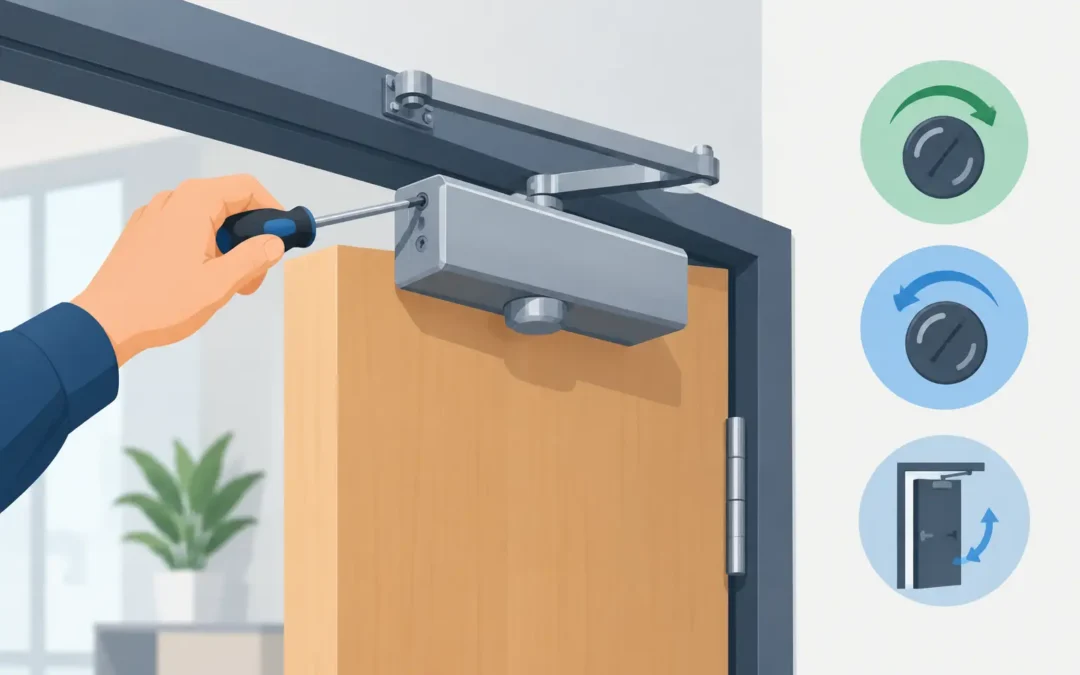
Look at the closer body, usually mounted at the top of the door or frame. You may see two or three small adjustment valves, often recessed and marked with letters, numbers, or directional arrows. The exact layout varies by manufacturer, so do not assume every closer uses the same valve positions.
The most common adjustments are sweep speed and latch speed. Sweep speed controls the door through most of its closing travel, typically from fully open to roughly the last 10 to 15 degrees. Latch speed controls the final portion of the cycle, where the latch must enter the strike and secure the door.
Some closers also include backcheck and delayed action. Backcheck cushions the door as it is opened forcefully, helping prevent the door or wall from being hit. It is not an opening stop and should not be used as one. Delayed action holds the door open longer before it begins its normal closing cycle, which can help at certain accessible openings.
Do not confuse hydraulic speed valves with the closer spring-power adjustment. Spring tension may be adjusted on some models, but it requires more care and is often best left to a qualified door technician. Increasing power can make a door harder to open and may create accessibility concerns.
How to Adjust a Door Closer Safely
Before making any adjustment, inspect the door. Confirm that it swings freely, the hinges are secure, the latch aligns with the strike, and nothing is rubbing at the top, bottom, or edge. A closer cannot overcome a door that is binding in the frame.
Use the correct screwdriver or hex key for the valve. Keep the tool seated firmly to avoid stripping the adjustment screw. Then make one small adjustment at a time – generally no more than one-eighth of a turn.
Adjust the Sweep Speed First
If the door moves too quickly through most of its closing path, turn the sweep valve in the direction marked to slow the action. On many closers, clockwise slows the valve, but markings and designs differ. Always follow the closer’s labels when they are present.
After each small turn, open the door and let it close from a normal opening position. Watch whether the door travels smoothly and predictably. A commercial door should not whip toward the frame, but it also should not take so long to close that it interferes with building security or normal use.
Fine-Tune the Latch Speed
Next, observe the final few inches of travel. If the door reaches the frame but does not latch, it may need slightly more latch speed. If it slams during the final closing motion, reduce the latch speed in a small increment.
The door should have enough energy to overcome latch resistance, weatherstripping, air pressure, and ordinary wind conditions. This is why a door that appears adjusted correctly while the building is quiet may fail at a busy exterior entrance. Test it several times, including from different opening positions.
Check the Entire Closing Cycle
Do not judge the adjustment by one close. Cycle the door at least five times. Verify that it closes and latches without help, does not slam, does not stall, and does not bounce back open after contacting the frame.
For a pair of doors with coordinators, panic hardware, automatic operators, or electromagnetic locks, adjustment can be more involved. Each device must work in the correct sequence. A change to one component can affect the entire opening.
Adjustments That Cause Problems
The most common mistake is turning a hydraulic valve too far. These valves are not meant to be removed. If a screw is backed out excessively, hydraulic fluid can leak from the closer. Once fluid loss occurs, the closer may not hold its settings and replacement is often the practical solution.
Avoid using the closer as a cure for a mechanical problem. If the door drags, the frame is bent, the hinges are worn, or the latch does not align, adding spring power or speeding up the closer may only mask the issue while putting more stress on the hardware.
Do not use a door closer to force a fire door shut against an obstruction. Fire-rated doors must self-close and self-latch, but they also need clear openings, compatible hardware, and proper inspection. Wedges, unapproved hold-open devices, and damaged closers can compromise the door’s intended fire protection.
When a Door Closer Needs Professional Service
A minor speed adjustment is reasonable when the door is otherwise in good condition. Service is the better option when the closer leaks oil, the arm is bent or loose, the door will not latch consistently, or the closer body is damaged.
Professional evaluation is also recommended for heavy doors, high-traffic entrances, fire-rated openings, and doors that need to meet accessibility requirements. The closing force must be balanced with the force required to open the door. That balance can be affected by door weight, hinge condition, gaskets, air pressure, and hardware configuration.
At commercial properties, an unreliable closer can create security and liability concerns quickly. An exterior door that does not latch can leave a building exposed. A door that closes too aggressively can create a hazard for employees, residents, students, and guests. Prompt repair protects the opening and helps avoid larger hardware failures.
Keep Closers Working Longer
Door closers last longer when the entire opening is maintained. Periodically check mounting screws, arm fasteners, hinges, latch operation, weather seals, and the door’s fit in the frame. Keep objects from blocking the swing path, and do not allow users to hang on the door or force it open beyond its intended range.
Seasonal changes can also affect operation. Cold weather can make hydraulic fluid behave differently, while wind and changing building pressure can alter how exterior doors close. A small seasonal adjustment may be appropriate, but repeated adjustment is a sign that the opening deserves a closer inspection.
For homeowners and facility managers across Northern Illinois and Southern Wisconsin, Barcol Door Company can help diagnose whether the issue is a simple closer setting, worn hardware, or a larger door and frame problem. The right repair is not always the fastest turn of a screw – it is the one that leaves the door closing securely, operating safely, and ready for daily use.