
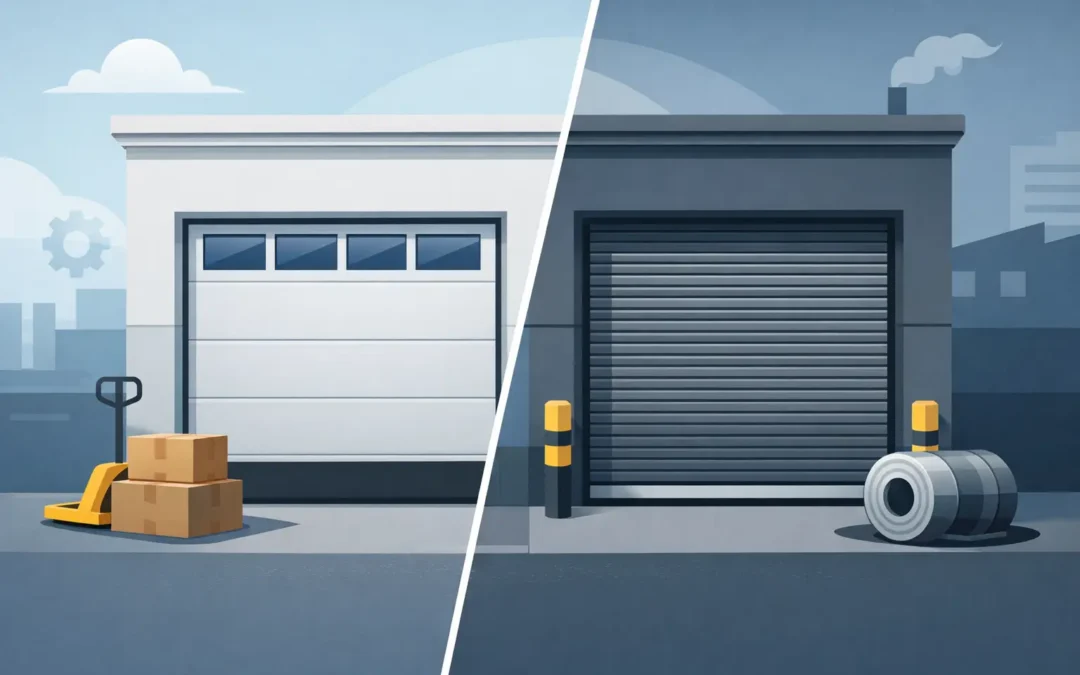
A warehouse loading opening, service bay, school receiving area, or retail stockroom has one job to do: move people, products, and equipment safely without becoming a daily maintenance problem. The sectional door vs rolling steel decision affects that job more than many owners expect. Both door types can provide dependable commercial access, but they operate differently, use overhead space differently, and fit different levels of security, traffic, and exposure.
The best choice is not simply the strongest-looking door or the lowest initial price. It is the door that fits the opening, the building layout, the operating cycle, and the facility’s long-term needs. A proper site review can prevent clearance conflicts, premature wear, and expensive changes after installation.
Sectional Door vs Rolling Steel: The Basic Difference
A sectional door is made of horizontal panels connected by hinges. It travels upward on tracks, follows a curved path, and rests flat or nearly flat beneath the ceiling when open. This familiar design is common in automotive service centers, fire stations, warehouses, municipal buildings, and many commercial facilities where overhead space is available.
A rolling steel door is made of interlocking steel slats. Instead of moving back along ceiling tracks, the curtain rolls into a coil above the opening. Rolling steel doors are frequently used at loading docks, storefront back rooms, self-storage facilities, distribution areas, parking structures, and industrial sites where security and compact overhead storage matter.
Both can be manually operated or powered with an operator. Both can be specified for commercial use. The difference comes down to how the door stores, how it is built, and what conditions it is expected to handle every day.
When a Sectional Door Is the Better Fit
Sectional doors are often the practical choice for facilities that need a wide opening, good thermal performance, and a finished appearance. Their panel construction allows manufacturers to offer insulated models with a range of R-values, window options, steel thicknesses, and exterior finishes. For a heated service department or an occupied work area, insulation can make a meaningful difference in comfort and energy use.
They also work well where the door will be seen by customers or the public. An auto dealership service drive, fire station, vehicle fleet building, or commercial storefront with visible bays may benefit from the cleaner architectural look of sectional panels. Full-view sectional doors are also available when daylight and visibility are priorities.
The trade-off is ceiling space. A standard sectional door needs room for horizontal tracks and the open door panels. High-lift and vertical-lift track configurations can address certain conditions, but they still require careful planning around lighting, ductwork, sprinklers, electrical conduits, and roof structure. In a crowded mechanical area, that overhead footprint can be a deciding factor.
Sectional doors also have more visible moving components, including rollers, hinges, cables, springs, and tracks. With professional installation and routine maintenance, they are dependable systems. Still, facilities with frequent use should plan for inspections, lubrication, spring adjustment, and replacement of worn components before a small issue becomes a door-down service call.
When Rolling Steel Makes More Sense
Rolling steel doors are built for situations where security, durability, and overhead clearance are the top concerns. Because the curtain coils above the opening, a rolling door leaves more ceiling area open than a sectional door. That can be especially valuable in loading areas with cranes, tall racking, overhead utilities, or low-clearance conditions.
The steel curtain provides a strong physical barrier when closed. For a warehouse access point, storage room, concession area, equipment enclosure, or receiving door that is unattended after hours, rolling steel can be the better security-focused option. Models can be specified in different gauges and slat profiles based on the opening size and the level of protection required.
Rolling doors are also a smart choice for openings that need to stay clear when the door is up. Since the curtain is contained in a coil, it does not extend deep into the building. This makes it easier to position shelving, equipment, or workstations near the opening, provided the required side room and headroom are available.
That compact design has limits. A rolling steel door needs enough headroom for its barrel and coil. Larger openings require larger coils, so the available space above the opening must be measured accurately. The door also has guides on both sides of the opening that must be securely mounted to suitable structure.
For climate-controlled spaces, a standard rolling steel door may not insulate as well as an insulated sectional door. Insulated rolling doors are available, but product selection should be based on the actual energy, noise, and temperature-control requirements of the building rather than assumptions about the door style.
Security, Weather, and Fire Protection
Security needs vary by building and opening. A sectional door with heavy-gauge steel panels, commercial hardware, and a properly installed operator can provide dependable protection for many facilities. Rolling steel is often selected when the opening requires a more industrial level of resistance or when a compact steel curtain is better suited to the application.
Weather exposure matters as well. If wind, snow, rain, and freezing temperatures are common concerns, the door must be specified with appropriate weather seals, bottom seals, track or guide details, and wind-load capability. A door that fits the opening but is not rated for the local conditions can create ongoing service issues.
Fire protection is a separate decision from basic security. Fire-rated rolling doors and counter shutters are designed for openings that require fire separation under applicable building codes. They may use fusible links, release devices, or other closing systems tied to the fire protection plan. A standard sectional door is not a substitute for a required fire-rated opening. Facility managers, contractors, and building owners should confirm code requirements early, particularly in schools, healthcare facilities, hospitality properties, and mixed-use buildings.
Cost Should Be Measured Over the Door’s Service Life
Initial cost is part of the decision, but it should not control the entire project. Door size, insulation, steel gauge, wind rating, fire rating, operator type, controls, glazing, finish, and installation conditions all affect the final price. A smaller standard sectional door may be less expensive than a rolling steel door, while a large insulated sectional system with high-lift tracks and commercial operators may require a more substantial investment.
Maintenance costs deserve equal attention. Sectional systems have several moving parts that need periodic service. Rolling steel doors have fewer components spread across the ceiling, but their curtains, guides, barrel assemblies, and operators still require inspection and adjustment. A door that receives heavy daily cycles should be serviced on a schedule, not only after it fails.
For busy facilities, downtime can cost more than a repair invoice. A receiving door that will not open can delay shipments. A service-bay door that will not close can affect security and employee safety. Choosing a commercial-grade door, operator, and hardware package suited to actual use is usually less expensive than repeatedly repairing equipment that was underspecified from the start.
Consider Traffic, Operations, and Safety
Ask how the opening is used during a normal week. A door opened a few times each day for deliveries has different needs than one cycling continuously through a production shift. High-cycle springs, heavy-duty operators, vehicle-detection devices, photo eyes, monitored safety edges, and access controls may be appropriate depending on the operation.
Door speed also matters. A large opening that is frequently used by forklifts or delivery vehicles may benefit from a properly matched operator that minimizes wait time without compromising safe operation. Every powered commercial door should include the safety features required for its application and be tested regularly.
The people using the door matter just as much as the equipment. If employees will operate it, controls should be clearly placed and easy to use. If the opening is near pedestrian traffic, safety devices and warning practices are essential. If only authorized staff should have access, key switches, card access, or other control options can be incorporated into the system.
Choosing the Right Door for Your Building
A sectional door is generally the better fit when insulation, appearance, wide-panel design, or daylight are priorities and the building has adequate ceiling space. A rolling steel door is often the stronger choice when overhead clearance is limited, security is a primary concern, or the open door must stay compact above the opening.
There are exceptions. A service facility may need rolling steel at a secured receiving opening and insulated sectional doors at customer-facing bays. A school may need a fire-rated rolling door at one opening, steel entry doors at another, and hardware upgrades throughout the building. The right solution is often a coordinated door and hardware plan, not a one-product answer.
Before ordering, have the opening measured and the surrounding conditions reviewed. Headroom, side room, ceiling obstructions, wall construction, electrical availability, wind exposure, fire-rating requirements, and cycle count should all be part of the conversation. Barcol Door Company helps commercial customers across Northern Illinois and Southern Wisconsin match door systems to real operating conditions, then provides professional installation and ongoing repair support.
A commercial door should make the workday easier, protect the facility after hours, and hold up under the demands placed on it. Choose the system that supports how your building actually operates, then keep it maintained by technicians who understand the equipment behind the opening.