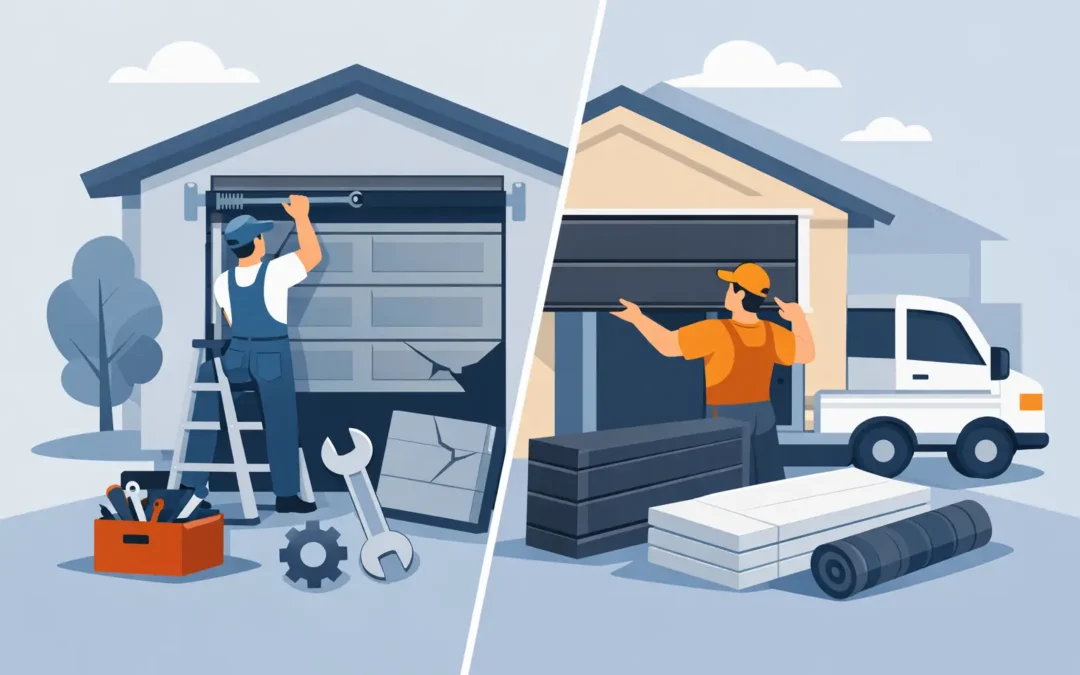
A garage door usually forces the issue at the worst time – when you are late for work, closing up a business, or trying to secure a property before the weather turns. In that moment, the repair vs replace garage door question becomes less theoretical and a lot more urgent.
The right answer depends on what failed, how old the door is, what shape the system is in overall, and whether a repair actually solves the problem or just delays a larger expense. For homeowners, that means balancing cost, curb appeal, and security. For commercial properties, it often means weighing downtime, safety, code requirements, and long-term reliability.
Repair vs replace garage door: start with the real problem
Not every garage door issue points to full replacement. In many cases, the door itself is still sound and the problem is limited to a component such as springs, rollers, cables, tracks, hinges, weather seal, or the opener. When the failure is isolated and the rest of the system is in good condition, a professional repair is usually the smart move.
A broken spring is a good example. Springs wear out over time, but a spring failure does not automatically mean the entire door is at the end of its life. The same is true for worn rollers, damaged hinges, noisy operation, or an opener that has become unreliable. If the panels are in good shape, the tracks are structurally sound, and the door still fits and seals properly, repairing the affected part can restore dependable performance without the cost of a full replacement.
On the other hand, some problems are bigger than a single part. If the door is badly dented, sagging, out of alignment, rusted through, or showing repeated issues across multiple components, repairs can start stacking up fast. At that point, replacing the door may be the more practical and cost-effective decision.
When repair makes more sense
Repair tends to be the better option when the issue is recent, localized, and economically fixable. A newer door with one failed component is often worth repairing, especially if the model is still serviceable and replacement parts are readily available.
This is also true when the problem does not affect the structural integrity of the door. Cosmetic damage, moderate hardware wear, minor track adjustments, sensor issues, and opener troubleshooting can often be handled without replacing the entire system.
For commercial properties, repair is often the first choice when it can minimize downtime and return the opening to safe operation quickly. A warehouse, dealership, school, or service facility usually wants the fastest dependable fix, not an unnecessary capital expense. If the door can be repaired safely and continue performing as expected, that is usually the right call.
The key word is safely. Garage doors carry significant weight and tension, and a low-cost repair only makes sense if it truly restores safe operation. If a repair leaves you with a door that is still unreliable, difficult to secure, or close to another failure, it is not really saving money.
When replacement is the better investment
Replacement makes more sense when the door has reached the point where repairs are no longer efficient. Age matters here, but age alone is not the only factor. Some older doors can continue performing well with proper service, while some newer doors wear out early because of heavy use, impact damage, poor installation, or neglected maintenance.
A full replacement is often the better investment when the door has major panel damage, extensive rust or rot, recurring spring and hardware failures, bent sections, compromised tracks, or poor insulation and sealing that affect comfort and energy use. It also makes sense when the door no longer matches the property, hurts curb appeal, or lacks modern safety and security features.
For commercial applications, replacement is often the right move when a door no longer meets operational demands. That may include repeated breakdowns, poor performance in high-cycle use, difficulty sourcing parts, or hardware that does not meet current code or safety expectations. In those cases, continuing to repair an outdated system can create more disruption than replacing it with a properly specified door.
Cost is important, but not by itself
Most people begin with price, and that is reasonable. A repair is usually less expensive upfront than a full replacement. But the real question is whether the lower cost today leads to a better result over time.
If you are paying for repeated service calls on an aging door, the short-term savings from another repair can disappear quickly. Two or three moderate repairs in a relatively short period may end up costing more than replacing the door once and getting a fresh start with new components, better operation, and warranty protection.
That said, replacement is not automatically the better financial decision either. If a quality door has years of useful life left and the issue is limited to one worn part, replacing the entire system would be excessive. The smartest decision comes from comparing the repair cost to the remaining life and condition of the door as a whole.
Safety changes the conversation
Some garage door decisions are really safety decisions. If the door is off track, drops unexpectedly, binds while moving, has frayed cables, broken springs, failing bottom sections, or opener issues that interfere with reversal and sensor performance, the problem should be treated as urgent.
For homeowners, that is about protecting family members, vehicles, and the home itself. For commercial facilities, the stakes can be even higher. Employees, customers, tenants, delivery personnel, and inventory may all be affected by an unsafe or unreliable opening.
In these situations, the repair vs replace garage door decision should not be based on price alone. If replacement is what it takes to restore safe and consistent operation, that is usually the correct path.
Appearance and property value still matter
Function matters first, but appearance should not be dismissed. A garage door takes up a large portion of the front elevation on many homes, and on commercial buildings it can influence how the entire property looks and performs.
If a residential door is badly faded, dented, mismatched, or outdated, replacement can improve curb appeal in a way that repairs cannot. That can matter whether you plan to stay long term or sell in the near future. A new door can also bring better insulation, quieter operation, and improved convenience with updated opener technology.
For commercial properties, appearance ties into professionalism as well as performance. A clean, properly operating door sends a stronger message than one that is patched together and visibly worn out. In customer-facing environments, that difference is noticeable.
A few situations where the answer is clear
Sometimes the choice is obvious. If a car hits the door and bends multiple sections, replacement is often more practical than trying to patch structural damage. If the door has widespread rust, wood rot, or panel failure, replacing it is usually the safer investment.
If the opener fails but the door is still in excellent condition, repair or opener replacement may be all you need. If the springs break on a relatively modern, well-maintained door, that is generally a repair situation. If parts are obsolete and the system has become unreliable, replacement usually makes more sense.
The point is that the best answer comes from the full condition of the system, not just the most obvious symptom.
Why a professional inspection matters
Garage doors are systems, not single parts. A loud door may have roller wear, track issues, spring fatigue, opener strain, and panel stress happening at the same time. Looking at only one symptom can lead to the wrong decision.
A professional inspection helps identify whether the issue is isolated or part of broader wear. It also helps you understand what can be repaired now, what may need attention soon, and whether replacement would give you a better long-term result. That kind of clear assessment is especially important for commercial buyers managing multiple openings or planning around budgets, schedules, and safety requirements.
For homeowners and businesses across Northern Illinois and Southern Wisconsin, working with an experienced local door company matters because service decisions are only as good as the diagnosis behind them. A company like Barcol Door Company can evaluate the condition of the full system and recommend the option that makes the most sense for your property, not just the quickest sale.
The best garage door decision is usually the one that solves the problem once, restores safe operation, and gives you confidence every time the door opens and closes. If a repair can do that, repair it. If it cannot, replacement is money better spent.