
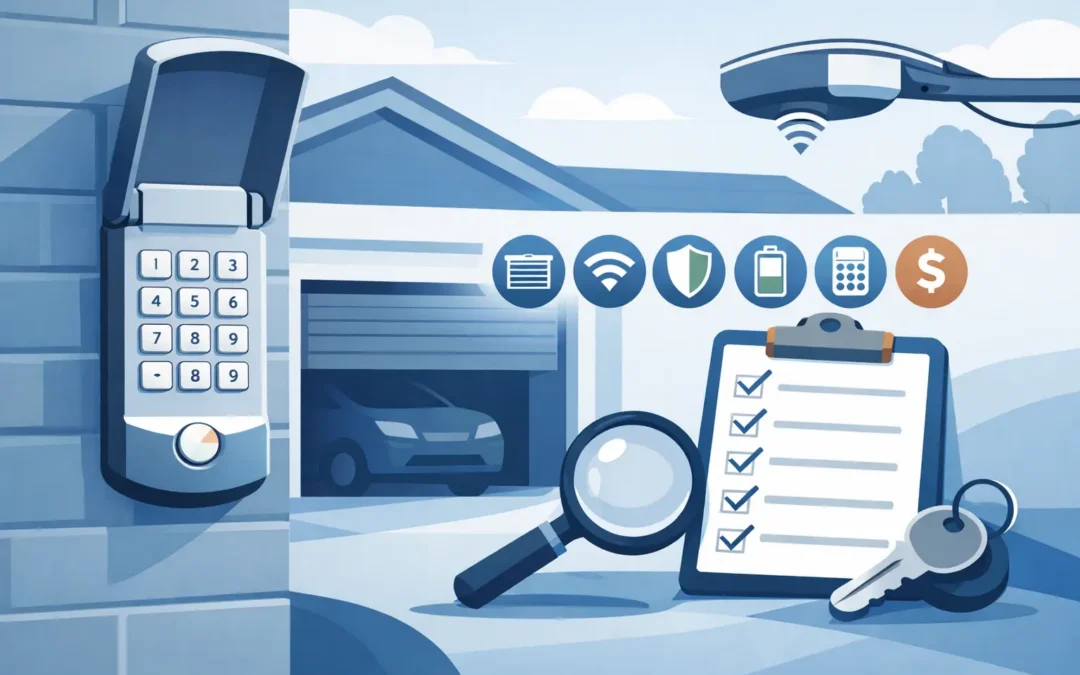
A garage door keypad seems like a small accessory until the day it saves you from a lost remote, a locked-out child, or a service appointment where someone needs access while you are away. This garage door opener keypad review focuses on the details that determine whether a keypad will be a dependable convenience or a frustrating purchase that never works correctly with your opener.
For most homeowners, the right choice is not necessarily the keypad with the longest feature list. It is the one that is compatible with the existing operator, holds up through Northern Illinois and Southern Wisconsin weather, and gives the household a secure, simple way to enter the garage.
1. Start With Opener Compatibility
Compatibility is the first requirement, and it is where many keypad purchases go wrong. Garage door openers use different radio frequencies, programming methods, and security technologies. A keypad that looks like it should fit a certain opener brand may still be incompatible with its production year or control system.
The most dependable option is usually an original manufacturer keypad made for the specific opener brand and generation. These keypads are designed to communicate with that operator’s receiver and generally follow a straightforward programming process. If your opener is newer, this is especially useful because modern rolling-code systems require the keypad and opener to exchange a changing security code.
Universal keypads can be a practical alternative when a household has more than one opener brand or an older unit with limited original accessories available. However, “universal” does not mean every model works with every opener. Always verify the keypad’s listed compatibility against the opener’s brand, model, and manufacture date before buying.
If the opener is very old, the better investment may be a new opener rather than another accessory. A new keypad cannot correct a failing receiver, worn motor components, or an obsolete security system.
2. Evaluate Security Before Convenience Features
A keypad is an exterior access point, so security deserves more attention than appearance. Modern rolling-code technology is the standard homeowners should expect. Each time the keypad is used, the operator recognizes a newly generated code rather than relying on one fixed transmission that could be copied.
Look for a keypad that allows you to select a personal identification number that is not easy to guess. Avoid using a house number, birth year, or a simple sequence such as 1234. A longer code may take an extra second to enter, but it is generally a better choice for a keypad installed in plain view beside the garage door.
Temporary PIN capability is one feature that can be genuinely useful. It allows homeowners to assign a separate code to a contractor, dog walker, house cleaner, or visiting family member, then remove it later. The value depends on the keypad and opener system. Some units limit temporary codes by time, while others provide a second code that must be manually deleted.
For families, a keypad can also reduce the need to hide a key outside the home. That convenience works best when everyone understands that codes should not be shared casually or written where they can be seen from the driveway.
3. Choose a Keypad Built for Outdoor Exposure
A garage door opener keypad lives outside year-round. In the Rockford area, that means summer heat, wind-driven rain, freezing temperatures, snow, road salt residue, and repeated freeze-thaw cycles. A low-cost keypad may work well in mild conditions but develop sticky buttons, faded labels, or moisture-related failures after a season or two.
A weather-resistant cover is worth having, particularly on a keypad mounted where it receives direct rain or snow. The cover helps keep water and debris out of the buttons and shields the face from sun exposure. It also makes the keypad less noticeable from the street.
Button design matters more than it may seem. Large, clearly marked keys are easier to use in the dark, while wearing gloves, or when someone is trying to get children and groceries inside during bad weather. Backlit buttons are helpful at night, but they increase dependence on battery condition. If visibility is a concern, choose a keypad with strong contrast between the number labels and the keypad face.
The installation location also affects durability. A keypad should be mounted on a solid surface near the garage entrance, at a convenient height, and away from areas where roof runoff regularly pours onto it. Mounting it too close to the door track, a metal obstruction, or an electrical source can sometimes interfere with signal performance.
4. Consider Battery Access and Everyday Operation
Most wireless garage door keypads run on batteries, commonly a 9-volt battery or coin-cell battery depending on the model. Battery-powered operation makes installation easier because there is no low-voltage wiring to run through an exterior wall. The trade-off is that the battery will eventually need attention.
A good keypad should make battery replacement simple without requiring removal from the wall. Check whether the battery compartment is protected from moisture and whether low-battery behavior is easy to recognize. Dimming lights, delayed response, intermittent operation, or a keypad that works only when standing very close to the door can all indicate a weak battery.
It is a good practice to replace keypad batteries on a regular schedule rather than waiting for a failure. Homeowners often pair battery replacement with daylight saving time, seasonal maintenance, or smoke detector checks. Keep the keypad manual or programming instructions in a safe place, since some models may require reprogramming after a battery change.
For households with multiple drivers, confirm that the keypad reliably activates the intended door. A two-door setup may require a keypad with separate buttons or programmed door selections. This feature is convenient, but it can add complexity during setup. Make sure each family member knows which button sequence operates each door.
5. Review Setup Requirements Honestly
Programming a compatible keypad is usually a manageable homeowner task, but “usually” is the key word. The process often involves pressing a learn button on the opener motor head, entering a PIN at the keypad, and completing the sequence within a limited time. The exact steps differ by manufacturer.
The difficult part is access. The learn button is typically located on the opener unit above the garage door, which may require a stable ladder and clear working space. If you are not comfortable working on a ladder or identifying the correct controls, professional service is the safer choice.
Before programming, test the garage door itself. The door should move smoothly, reverse properly when it meets an obstruction, and remain balanced. A keypad can send the right signal, but it cannot solve a door that binds in the tracks, has damaged springs, or needs opener adjustment.
If a new keypad will not program, do not assume the keypad is defective. Common causes include an incompatible model, a weak keypad battery, an opener that is in lock mode, radio interference, or a failed receiver board. An experienced technician can identify the cause quickly and prevent unnecessary replacement purchases.
6. When a Keypad Is Worth Replacing
Replace a keypad when buttons no longer respond consistently, the cover or housing is cracked, the programming no longer holds, or battery changes do not restore normal operation. Visible corrosion inside the battery compartment is another sign that moisture has affected the unit.
A replacement also makes sense after moving into a home. Clearing the opener’s stored codes and programming new remotes and a new keypad gives the new owner control over who has access. The same step is wise after a remote has been lost or stolen.
There are times when keypad replacement alone is not enough. If the opener is noisy, unreliable, lacks modern safety features, or is near the end of its service life, a new opener can provide quieter operation, better lighting, updated security, and a properly matched keypad. The right decision depends on the condition of the complete system, not just the exterior keypad.
A Practical Recommendation for Homeowners
For a single residential door with a newer opener, choose the manufacturer-approved keypad with rolling-code security, a weather-protective cover, illuminated buttons, and easy battery access. For mixed-brand or multi-door garages, a carefully verified universal keypad may be the more practical choice, provided every opener is listed as compatible.
Barcol Door Company can help homeowners determine whether a keypad issue is a simple accessory replacement or a sign that the opener or door needs service. A keypad should make daily access easier, not create uncertainty at the driveway. Choosing the correct unit and having it programmed properly gives you a convenient entry point that works when you need it most.