
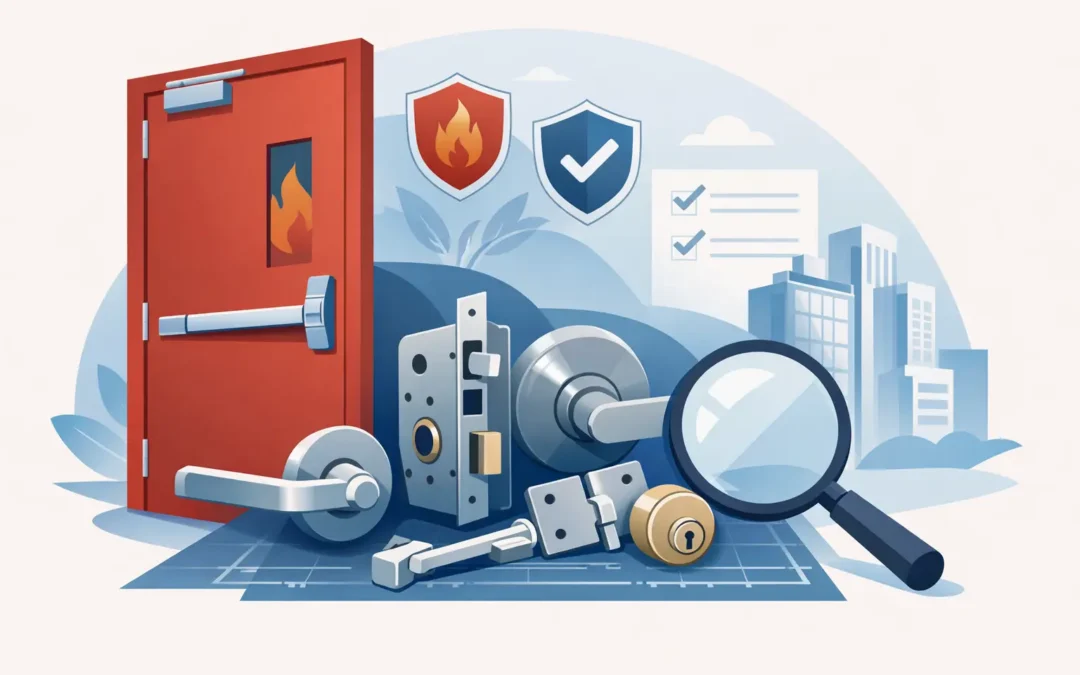
A fire door can have the correct label and still fail its purpose if the hardware does not allow it to close, latch, and remain secure during a fire. That is why learning how to select fire door hardware starts with the complete opening, not with a closer, lock, or panic device picked in isolation. For facility managers, contractors, and building owners, the right choice protects occupants while keeping high-use doors practical for daily operation.
Start With the Rated Door Assembly
Fire-rated openings are tested as assemblies. The door, frame, hinges, latch, closer, glazing, gasketing, and other components must work together as intended. Before specifying or replacing hardware, confirm the fire rating of the door and frame, the opening location, and the applicable code requirements for the building.
A 20-minute door, a 45-minute door, and a 90-minute door may require different hardware considerations. The opening may also be part of a corridor, stair enclosure, smoke barrier, exit route, or hazardous-area separation. Each location affects the hardware needed to maintain life safety and code compliance.
Read the labels already present on the door and frame. If the labels are missing, painted over, damaged, or inconsistent with the opening, do not assume replacement hardware will solve the issue. A qualified door professional should evaluate the opening before work begins.
Choose Listed and Compatible Hardware
Hardware used on a fire door must be suitable for that application. This does not simply mean selecting a heavy-duty commercial product. It means verifying that the product is listed or labeled for use on the specific fire-rated opening and that its installation does not compromise the door or frame.
A lockset, exit device, hinge, closer, or accessory can create a problem if it requires unapproved field modifications, conflicts with the door label, or prevents positive latching. For example, drilling new holes, cutting the door for an incompatible device, or installing decorative hardware not approved for the opening can jeopardize the assembly.
When comparing products, ask for documentation that confirms fire-door suitability. Product ratings, certifications, and manufacturer instructions matter. So does matching the hardware preparation already in the door whenever possible. Reusing existing preparations can reduce cost and downtime, but only when the existing opening is in good condition and the replacement is compatible.
Do Not Overlook the Frame
The frame is more than a place to mount hinges and strike plates. It is part of the rated opening. A misaligned frame, damaged strike reinforcement, loose anchors, or excessive clearance can keep a properly selected door from closing and latching.
This is common in older schools, multifamily properties, hospitality facilities, and industrial buildings where doors receive years of hard use. In those cases, a hardware replacement may need to include frame repair, hinge reinforcement, strike adjustment, or a new labeled frame to produce a dependable result.
Make Sure the Door Closes and Latches Every Time
The central job of fire door hardware is straightforward: the door must self-close and positively latch when released. A door held open with a wedge, blocked by damaged flooring, or unable to latch because of misalignment is not providing the protection it was designed to provide.
A door closer should be sized for the door weight, width, height, swing, and traffic level. A closer that is too weak may not close the door against air pressure or seals. One that is too powerful can make the opening difficult to use, especially for children, older adults, and people using mobility devices.
Proper adjustment is just as important as product selection. Closing speed, latching speed, backcheck, delayed action where permitted, and spring power should be adjusted for real conditions at the opening. An exterior vestibule, a busy school corridor, and a quiet mechanical room do not operate the same way.
Positive latching requires the latch bolt to engage the strike when the door closes. Roller latches, ball catches, magnetic catches, and unapproved hold-open methods generally do not provide the required latching function for a fire door. If a door has an exit device, the device and its latch components must be appropriate for the rated opening.
Balance Fire Protection With Egress and Access
Fire door hardware often has to solve several needs at once: fire protection, safe egress, security, accessibility, and controlled access. The right answer depends on how people use the opening and what happens during an emergency.
Exit doors in assembly spaces, schools, healthcare settings, and many commercial occupancies may require panic or fire exit hardware. Fire exit hardware is designed for openings that need a fire-rated latching system and immediate egress. It should release with a single, familiar action from the egress side without keys, special knowledge, or excessive force.
Electrified locks, card readers, delayed-egress systems, and access-control components require additional planning. They must coordinate with the fire alarm system, emergency release requirements, power-loss behavior, and local code provisions. A secure opening that does not release correctly in an emergency is not an acceptable trade-off.
Accessibility also needs attention. Lever-operated hardware, mounting heights, opening force, closer adjustment, and maneuvering clearance all affect whether people can use the door safely. The goal is not merely to install compliant products on paper. It is to create an opening that works for the people passing through it every day.
Select Components for Daily Wear
Fire-rated hardware should be selected for the building’s traffic level, not only for its fire label. A utility-room door used twice a week has different needs than a classroom door, hotel stair door, or employee entrance opened hundreds of times per day.
Hinges must carry the door weight without sagging or binding. Heavy doors, tall doors, high-frequency openings, and doors with closers or exit devices may need ball-bearing hinges, continuous hinges, or other heavy-duty options. The wrong hinge choice can cause dragging, poor latching, damaged frames, and early closer failure.
Closers and exit devices should also be selected with maintenance in mind. Durable commercial-grade hardware costs more upfront than light-duty alternatives, but repeated repair calls, failed inspections, and premature replacement can cost far more over the life of the opening.
Finishes are a practical consideration as well. In healthcare, food service, education, and high-touch public spaces, finishes may need to support cleaning requirements and resist wear. In corrosive or exterior conditions, hardware materials should be chosen for moisture, salt exposure, temperature swings, and other environmental demands.
Review Door Pairs, Coordinators, and Smoke Control
Paired fire doors need special attention because both leaves must close in the correct order and latch properly. If one leaf has an astragal or overlapping edge, a coordinator may be needed to ensure the inactive leaf closes before the active leaf. Improper sequencing is a frequent reason paired openings fail to latch.
Some openings also require smoke and draft control. Gasketing, door bottoms, and perimeter seals can limit smoke movement, but they must be compatible with the door assembly and must not interfere with closing and latching. Adding a seal without checking clearances can turn a reliable door into one that no longer closes.
Hold-open devices are another area where shortcuts create risk. Fire doors cannot be casually propped open for convenience. Where operational needs require the door to remain open, use an approved hold-open arrangement tied to the building’s fire alarm or detection system, as permitted by code.
Plan for Inspection, Maintenance, and Replacement
Selecting the hardware is only the beginning. Fire doors need routine inspection and maintenance because normal traffic, settling, abuse, and building changes can affect performance. Facilities should regularly check that doors close from the fully open position, latch without manual assistance, have intact labels, and are free from unauthorized modifications.
Watch for bent hinges, loose screws, leaking closers, damaged gasketing, misaligned strikes, field-installed signs or kick plates, and doors that rub the frame or floor. Small problems become larger compliance and safety issues when they are ignored.
When replacing a single component, document what was installed and why. This helps maintenance teams preserve consistency across a facility and gives future contractors a clearer picture of the opening. It is especially valuable for campuses, assisted living properties, hotels, and multi-building operations with many rated openings.
Get a Complete Opening Evaluation
The best way to avoid costly rework is to evaluate the entire opening before ordering hardware. A knowledgeable commercial door provider can verify ratings, identify incompatible components, measure clearances, review egress needs, and recommend hardware that fits both the code requirements and the way the building operates.
Barcol Door Company helps commercial customers across Northern Illinois and Southern Wisconsin with fire-rated doors, frames, hardware, installation, repair, and ongoing support. For a new project or a problem opening, experienced evaluation can prevent a simple hardware change from becoming a failed inspection or a larger replacement job.
A fire door should not be judged by how it looks when closed. It should be judged by whether it closes, latches, releases for egress, and performs as intended when the building needs it most.