
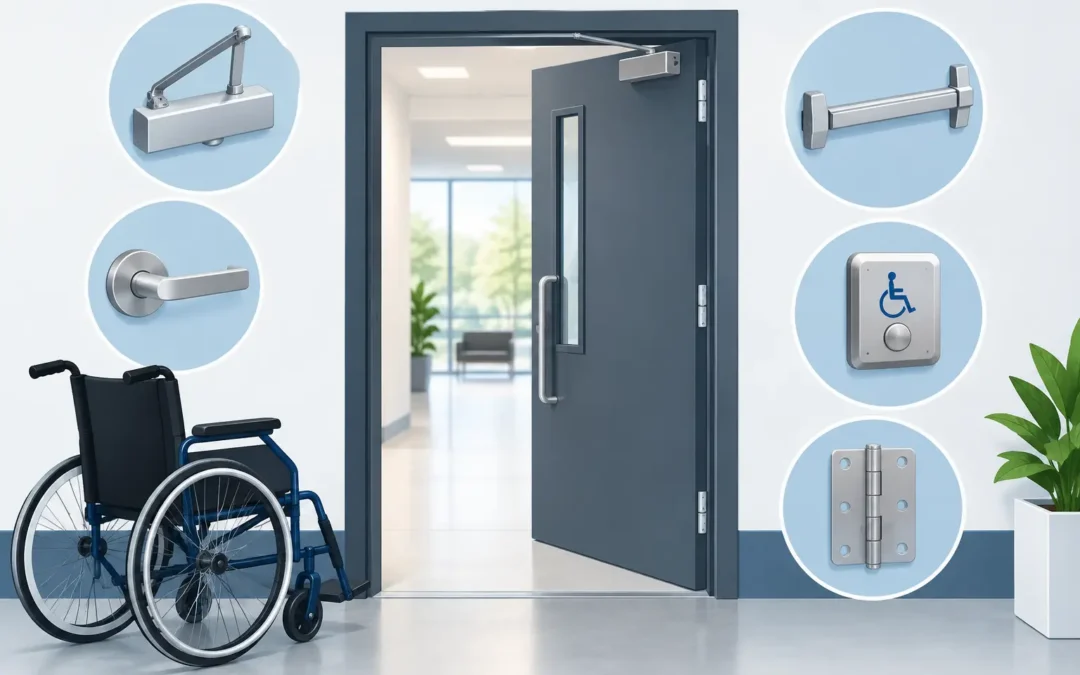
A door can look commercial-grade and still create an access problem. A round knob that requires twisting, a closer that shuts too quickly, or a threshold that catches a wheelchair can all prevent people from using an entrance independently. When facility teams ask, “what hardware is required for ADA doors,” the answer is not one product. It is a coordinated set of door, frame, hardware, and operating-force decisions.
For schools, healthcare-related facilities, offices, hospitality properties, retail spaces, and multifamily buildings, the goal is straightforward: provide an accessible opening that works reliably every day. The correct hardware depends on the door location, occupancy, fire rating, egress requirements, and local code enforcement. ADA requirements also work alongside the International Building Code, local building codes, and life-safety rules.
ADA Door Hardware Requirements at a Glance
At an accessible door, the hardware must be usable with one hand and without tight grasping, pinching, or twisting of the wrist. In practical terms, that usually means lever handles, push/pull hardware, panic devices, or automatic operators instead of traditional round knobs.
Operable parts generally need to be mounted within the accessible reach range. For door hardware, this commonly means the centerline of the hardware is 34 to 48 inches above the finished floor. Door closers, latches, thresholds, hinges, and locking hardware must also work together without making the door too difficult to open or pass through.
Not every door in a building has identical ADA obligations. A closet door, mechanical-room door, fire exit, employee-only opening, or tenant entry may have different requirements based on the building layout and applicable code. That is why hardware should be reviewed as part of the entire opening rather than selected one piece at a time.
Lever Handles and Accessible Locks
Lever handles are the most common ADA-compliant operating hardware for swinging doors. A user can depress a lever with a hand, closed fist, or forearm without needing the gripping strength or wrist movement required by a knob.
The lever itself is only part of the decision. The latch and lock function matter just as much. Classroom, storeroom, office, privacy, passage, and entrance functions each operate differently. A facility may need controlled access on the exterior side while maintaining free egress from the inside. On restroom doors, privacy hardware must be easy to operate and allow emergency access when required.
Electronic access control can also be part of an accessible opening. Card readers, keypads, electric strikes, electrified trim, and request-to-exit devices should be located where users can reach and operate them. If the locking system requires a user to pull a heavy door open immediately after presenting a credential, an automatic operator may be the practical solution.
Door Closers, Opening Force, and Closing Speed
A properly selected door closer is essential, especially on exterior and fire-rated doors. However, a closer adjusted too aggressively can turn an otherwise compliant opening into a daily obstacle.
For interior hinged doors, ADA standards generally limit opening force to 5 pounds. Exterior doors and fire doors may be governed differently because closing force is necessary for weather protection, security, and fire-latch performance. In those cases, the door must still be adjusted to the minimum force needed for reliable operation. Local building and fire codes may add their own requirements.
Closing speed also matters. A door with a closer should take at least five seconds to move from 90 degrees open to 12 degrees from the latch. This gives a person using a wheelchair, walker, cane, or mobility device enough time to clear the opening. The latch speed should be controlled as well, so the door closes and latches without slamming.
A closer cannot be evaluated in isolation. Door weight, hinge condition, frame alignment, weatherstripping, air pressure, latch engagement, and threshold height all affect how much effort is required. An old door that drags on the frame can feel much heavier than its closer adjustment suggests.
Thresholds, Hinges, and Clear Opening Width
While people often focus on handles and closers, accessible door performance begins with physical clearance. ADA-compliant doors on an accessible route generally need a minimum 32 inches of clear width when the door is open 90 degrees. The clear opening is measured between the face of the door and the stop, not simply by the nominal door size.
A 36-inch door is frequently used to achieve the required clear opening, but frame details, hinges, and door thickness can affect the final measurement. In existing buildings, a smaller opening may require a wider door, offset hinges, frame modifications, or a different approach to improve access.
Thresholds at accessible doors should be low and beveled where required. A tall, square-edged threshold creates a trip hazard and can stop wheels at the doorway. Standard ADA guidance limits thresholds to 1/2 inch high, with changes in level greater than 1/4 inch typically requiring a beveled edge. Exterior conditions, drainage, and weather protection make threshold selection particularly important in Northern Illinois and Southern Wisconsin.
Hinges must allow the door to swing freely and maintain proper alignment. Ball-bearing hinges are often a smart choice for heavier commercial doors because they reduce wear and support smoother operation. Continuous hinges may be appropriate for high-use openings, but the complete door assembly still needs to meet clearance, force, and fire-rating requirements.
Panic Hardware and Fire Exit Devices
Panic hardware is not automatically required by ADA, but it is often required by life-safety code for certain occupancies and occupant loads. Where a panic device is installed, it must be easy to operate and should not require tight grasping, pinching, or twisting.
The active portion of a panic device must extend at least half the width of the door leaf. Crossbar-style devices and push-pad exit devices are common solutions. The device should release the latch with a single pushing motion, allowing occupants to exit quickly during an emergency.
On fire-rated openings, the device must be listed and compatible with the rated door and frame assembly. Fire exit hardware has additional requirements, including positive latching. Substituting hardware or drilling the door in the field without confirming listing details can compromise the opening’s fire rating and create inspection issues.
Exit hardware also needs to coordinate with access control. Delayed-egress locks, electromagnetic locks, alarmed exits, and electrified panic devices can be appropriate in certain facilities, but they must release properly during a fire alarm, power loss, or other required emergency condition. This work calls for careful coordination among the door supplier, electrician, access-control provider, and authority having jurisdiction.
Automatic Operators: When They Make Sense
ADA does not require every accessible door to have an automatic operator. A properly designed manual door with compliant hardware, clearance, and opening force can meet accessibility requirements. Still, low-energy power operators are a valuable option at entrances that are heavy, frequently used, exposed to wind pressure, or difficult to operate manually.
Automatic operators are commonly installed at medical offices, senior living facilities, schools, public buildings, and busy commercial entrances. They may be activated by push plates, wireless transmitters, card readers, motion sensors, or other controls. Activation devices need to be placed within reach range and located where a user can safely approach the door.
A power operator also needs the right safety equipment. Depending on the application, this may include guide rails, overhead sensors, presence sensors, signage, and appropriate hold-open timing. The operator must coordinate with the door closer, latch, electric lock, and fire alarm system. A poorly coordinated automatic opening can damage hardware, fail to latch, or create a safety concern.
Do Not Overlook Maneuvering Clearance
The space around the door is as important as the hardware on it. ADA standards require maneuvering clearance on the pull side and push side of accessible doors, with dimensions that vary based on the direction of travel, closer use, latch location, and approach.
For example, a person approaching a pull-side door needs room to position beside the latch, open the door, and move through it. Furniture, planters, vending machines, railings, mats, or stored supplies can eliminate that usable space even when the door itself has compliant hardware.
This is a common issue in existing buildings. Replacing a knob with a lever is a worthwhile improvement, but it may not solve the problem if the door is too narrow, the closer is too strong, or the approach is blocked.
A Practical Approach to ADA Door Hardware
The most reliable way to specify accessible hardware is to review each opening by use and condition. Start with the door’s purpose: Is it a public entrance, restroom, classroom, tenant suite, service corridor, fire exit, or secured staff entrance? Then confirm door width, threshold height, handing, fire rating, security needs, closer force, and required egress function.
For new construction, hardware should be scheduled early so the door, frame, lockset, closer, exit device, and access-control components are compatible. For existing facilities, an opening-by-opening assessment can identify the upgrades that will make the greatest difference without replacing more than necessary.
Barcol Door Company helps commercial customers evaluate, supply, install, and repair commercial doors and hardware across Northern Illinois and Southern Wisconsin. Whether the need is a lever lockset, new closer, panic device, automatic operator, or a complete hollow metal opening, expert installation helps protect both code compliance and day-to-day performance.
Accessible doors should not feel like a special accommodation or a constant maintenance problem. With the right hardware and proper adjustment, they become what every entrance should be: safe, dependable, and easy for everyone to use.