A classroom door that will not latch, an entrance that closes too quickly, or a panic device that sticks can disrupt far more than a maintenance schedule. The best commercial door hardware for schools protects students and staff, supports daily traffic, meets code requirements, and gives facility teams equipment they can depend on year after year.
Schools place unusual demands on every opening. Hundreds of students may use the same door in a single day. Doors must allow fast egress during an emergency, controlled access during the school day, and reliable operation during arrival, dismissal, events, and after-hours use. Choosing hardware is not simply a matter of selecting locks and closers. It requires looking at each opening, its purpose, its traffic level, and the applicable building, fire, accessibility, and life-safety requirements.
What Makes the Best Commercial Door Hardware for Schools?
The right specification starts with the door’s job. A main entrance, classroom, restroom, exterior exit, gymnasium, kitchen, and mechanical room should not receive the same hardware package. A school can reduce repair calls and improve security by matching every component to the opening rather than applying one standard set of hardware throughout the building.
Durability is the first consideration. Commercial-grade hinges, closers, exit devices, locksets, and trim are built for frequent use, but grades and construction details still matter. High-traffic openings need hardware rated to handle repeated cycles without loosening, sagging, leaking, or failing to latch. Lower-cost hardware may appear similar at installation, yet it often creates recurring adjustment and replacement costs in a busy school.
Code compliance is equally important. Hardware must work with the door and frame assembly, especially on fire-rated openings. It must also preserve accessible operation for students, staff, parents, and visitors. A qualified commercial door professional can identify where a change to a lock, closer, lever, or exit device may affect the opening’s rating or code compliance.
Exterior entrances need security without slowing the day
School entry doors need controlled access, weather resistance, and dependable closing. Electrified locks, card readers, keypads, intercoms, and remote release systems can help staff manage who enters the building. The best choice depends on how the school handles visitors, deliveries, early arrivals, and after-hours activities.
An access control system should not compromise emergency egress. In most applications, people inside must be able to exit immediately without special knowledge, a key, or a credential. This is why electrified hardware should be planned as part of the full opening, including the exit device or lockset, power transfer, door position switch, closer, frame, and alarm or access system.
Exterior doors also need proper weather seals, thresholds, sweeps, and door bottoms. These components help reduce drafts, water infiltration, noise, and wear. They are small parts with a large effect on comfort and operating costs, particularly in Northern Illinois and Southern Wisconsin winters.
Classroom hardware should support safety and daily use
Classroom doors are among the most frequently used openings in a school. Lever locksets are generally the practical choice because they are easier to operate than knobs and better suited to accessibility requirements. Functions should be selected based on the school’s safety plan and local code requirements, not on a one-size-fits-all product decision.
Many schools evaluate classroom security functions that allow staff to secure the room from inside while maintaining free egress. The details matter. Staff should be able to understand the operation quickly, substitute teachers should not need special training to use it, and students should always be able to exit without delay. Before changing classroom locks, confirm that the proposed function works with the door, frame, fire label, district policy, and authority having jurisdiction.
Door closers are another essential part of classroom performance. A closer must reliably shut and latch the door without requiring excessive force. If it closes too hard, it creates noise, damaged frames, and a potential injury concern. If it closes too slowly or lacks enough closing force, the latch may not engage and the opening may not provide the security or fire protection intended.
Hardware That Deserves Close Attention
A school hardware package is only as dependable as its working parts. The following items deserve careful review during new construction, renovation, or replacement planning:
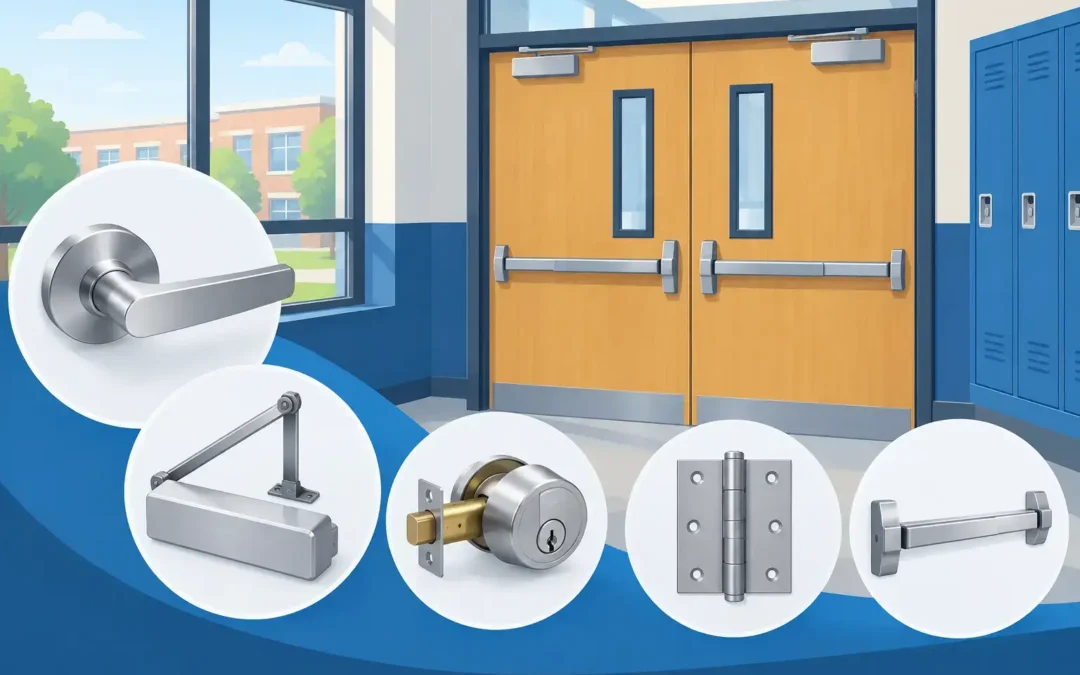
- Continuous hinges or heavy-duty ball-bearing hinges help support heavy doors and frequent traffic. Continuous hinges can be especially useful where door sag, hinge wear, or abuse has been a repeated problem.
- Commercial door closers should be selected for door size, weight, location, wind exposure, and traffic. Adjustable closing and latching speeds allow technicians to fine-tune performance.
- Panic hardware and fire exit hardware provide immediate egress on required exit doors. Fire-rated doors require compatible, labeled hardware that positively latches when closed.
- Commercial lever locks and cylindrical or mortise locksets should match the use of the opening. Higher-security or higher-traffic areas may justify a more substantial lock body and trim.
- Kick plates, edge guards, latch protectors, and door stops reduce damage from carts, backpacks, equipment, and everyday use. They are inexpensive compared with replacing a damaged door or frame.
Door protection is often overlooked until repairs become routine. In cafeterias, gyms, corridors, and service areas, a properly placed kick plate or edge guard can extend the life of a door considerably. The same is true for wall stops and overhead stops that prevent door handles from damaging walls, glass, or adjacent equipment.
Fire-rated openings cannot be treated as ordinary doors
Fire doors, frames, and hardware work as a tested assembly. A door closer, positive-latching device, hinges, coordinator, astragal, or hold-open system may all affect the opening’s ability to perform as intended during a fire. Replacing a failed part with an incompatible product can create a compliance issue even if the door appears to operate normally.
Common trouble signs include doors that are propped open, latches that do not catch, missing or painted-over labels, field-drilled holes, damaged gasketing, and gaps that have changed after years of use. Fire door inspections and timely repairs help schools identify these issues before they become a bigger safety or compliance problem.
Accessibility is part of practical design
Accessible hardware benefits everyone, including students carrying books, staff moving supplies, and visitors with limited mobility. Lever handles, properly adjusted closers, accessible opening force, adequate maneuvering clearance, and low-energy operators where appropriate can make a major difference in how a school functions.
Automatic operators are particularly useful at primary entrances, administrative offices, health rooms, and other locations where independent access is a priority. They must be selected and installed correctly, with activation devices, safety sensors, and hardware that work together. An operator cannot compensate for a warped door, failing closer, dragging threshold, or misaligned frame.
Plan for Maintenance Before Hardware Fails
The strongest hardware will still need adjustment in a school environment. A practical maintenance plan includes checking hinge screws, closer arms, latch engagement, panic device operation, weather seals, door alignment, and access-control components. Facility teams should also watch for doors that slam, bind, fail to latch, scrape thresholds, or require unusual force to open.
Keeping a record of repeated repairs is useful. If one opening needs adjustment several times each semester, the cause may be a worn hinge, damaged frame, incorrect closer, excessive door weight, or an issue with the hardware specification itself. Repairing the root cause is more cost-effective than continuing to replace small parts.
For renovation projects and new schools, involve a commercial door and hardware professional early. This helps prevent mismatched doors, frames, locks, and electrified components that can delay occupancy or create costly changes later. Barcol Door Company helps schools and commercial facilities evaluate, supply, install, and repair complete door openings, from hardware and hollow metal doors to frames and fire-rated products.
A dependable school door should close, latch, secure, and allow safe exit without becoming a daily concern for staff. When hardware is specified for the opening, installed correctly, and serviced before minor issues grow, it quietly does exactly what a school needs it to do: keep the day moving safely.