
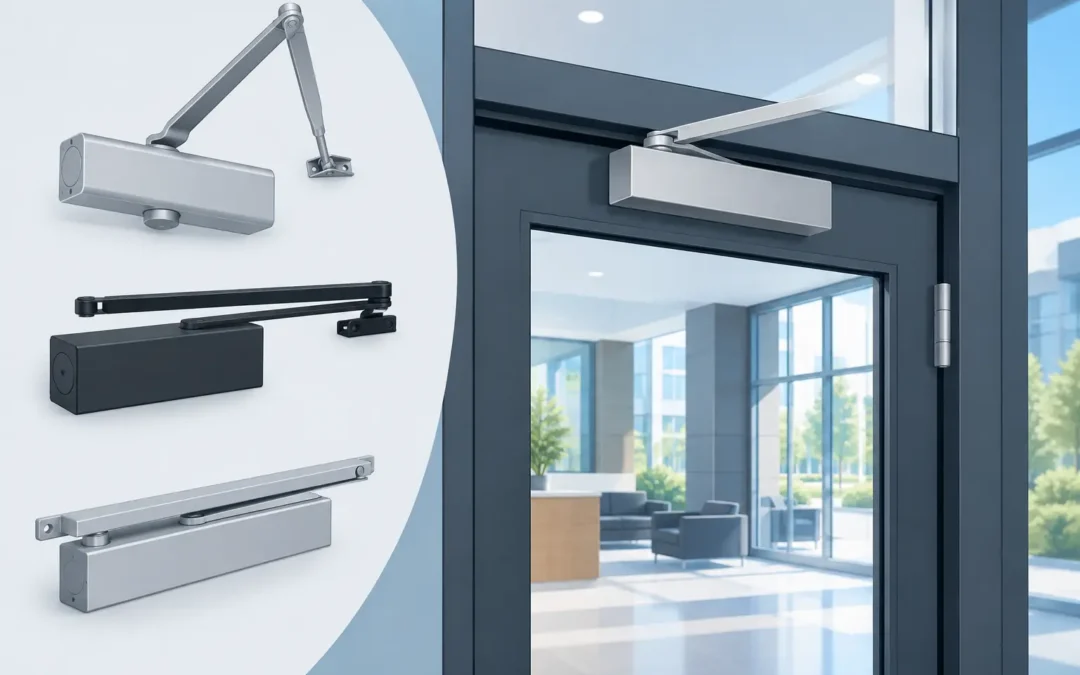
A commercial door closer has a simple job: close and latch the door every time. In a school corridor, healthcare facility, retail entrance, or apartment building, failure to do that job can create security problems, code concerns, energy loss, and a steady stream of repair calls. The best door closers for commercial buildings are not always the most expensive models. They are the closers correctly matched to the opening, the traffic level, the door weight, and the building’s code requirements.
For facility managers, contractors, and property owners, choosing the right closer starts with the entire opening. The door, frame, hinges, lockset, panic hardware, weatherstripping, fire label, and user needs all affect the decision. A closer that works well on a light interior office door may not control a heavy exterior steel door exposed to Northern Illinois wind and winter weather.
What Makes a Commercial Door Closer a Good Choice
A dependable commercial closer provides controlled closing without making the door unnecessarily difficult to open. It should bring the door from full open to a few inches from the frame at a safe speed, then provide enough final latching power to engage the latch and secure the opening.
The basic performance factors are closing force, control adjustments, durability, mounting style, and compatibility with the rest of the hardware. On a busy opening, quality internal seals and valves matter. A lower-cost closer may perform acceptably at first, then begin leaking oil or lose adjustment after repeated cycles. That is not a good value when the opening serves hundreds of people each day.
Commercial closers are commonly specified by ANSI/BHMA grade. Grade 1 is generally the right starting point for high-traffic commercial, institutional, and public openings. Grade 2 can suit moderate-use locations, while Grade 3 is more appropriate for light-duty applications. A grade designation is useful, but it should not replace a full review of the door and the conditions around it.
Spring Power Must Match the Door
Door closers are rated by spring power, often described as sizes from 1 through 6. Larger and heavier doors need more closing force. Exterior doors may also need additional power to overcome wind pressure, weather seals, air pressure differences, or heavy latching hardware.
Too little power leaves the door short of the latch, especially in cold weather or when seals tighten. Too much power can make the door difficult to open and create accessibility concerns. Adjustable spring closers offer useful flexibility, but adjustment has limits. A very heavy door should not be treated as a light door simply because an adjustable closer is available.
Control Is More Than Closing Speed
Most commercial closers allow technicians to adjust sweep speed, latch speed, and backcheck. Sweep speed controls most of the door’s travel. Latch speed controls the last few inches before the door reaches the frame. Backcheck cushions the door as it approaches the open position, helping protect walls, frames, and hardware when someone pushes the door open quickly.
Some closers also offer delayed action. This feature holds the door open briefly before the closing cycle begins, which can help people carrying materials, moving carts, or using mobility devices. Delayed action is useful in the right setting, but it is not a substitute for a properly designed accessible entrance or automatic operator where one is needed.
Best Door Closers for Commercial Buildings by Application
There is no one closer style that fits every commercial opening. The best selection depends on how the opening is used and what the door must accomplish.
Parallel Arm Closers for Public-Facing Openings
Parallel arm surface closers are a common choice for schools, offices, retail spaces, healthcare facilities, and other public-facing areas. The arm sits parallel to the door when closed, which reduces projection into the opening and gives the installation a cleaner, less vulnerable profile.
This mounting style is often preferred where appearance, safety, and resistance to misuse are important. It works well on interior and exterior doors when correctly specified. Because mounting conditions vary, the frame face and door construction should be checked before selecting the closer body and arm package.
Regular Arm Closers for Strong Closing Power
Regular arm, or standard arm, closers are typically mounted on the pull side of the door. Their geometry can provide strong closing performance, making them a practical choice for service doors, utility rooms, mechanical areas, and certain exterior openings.
The trade-off is that the arm projects farther from the door. That may be acceptable in employee-only or back-of-house areas, but it is often less desirable where people pass close to the opening or where appearance is a priority.
Top Jamb Closers for Glass or Narrow-Top-Rail Doors
Top jamb closers mount on the frame above the door. They are frequently used on aluminum storefront doors, glass doors with narrow top rails, and other openings where a traditional door-mounted closer body is not practical.
These closers can be an excellent solution, but the frame must be suitable for mounting and reinforcement. Storefront openings also deserve careful review for door weight, pivot condition, weather exposure, and air pressure. A closer cannot compensate for a worn pivot or a door that is out of alignment.
Concealed Closers and Floor Springs for Design-Sensitive Spaces
Concealed closers and floor springs can preserve a clean architectural appearance because much of the hardware is hidden within the door, frame, or floor. They are often found in upscale offices, hospitality properties, glass entry systems, and specialty interior openings.
They can be effective, but repairs are usually more involved than with a surface-mounted closer. Floor springs require proper floor preparation and can be costly to access when service is needed. For a high-use entrance, it is wise to weigh the appearance benefit against long-term maintenance requirements.
Fire-Rated Doors Need the Right Closer and Hardware
A fire door is designed to close and latch during a fire event. Its closer is not an accessory. It is part of the opening’s life-safety system.
On a labeled fire door, the closer, hinges, latch, frame, and other components must work together without unapproved modifications. A door held open with a wedge, trash can, or mechanical hold-open arm can defeat the purpose of the opening. When a hold-open function is needed on a fire-rated door, it must be part of an approved system that releases upon alarm or power loss as required.
If a fire door is slamming, failing to latch, dragging on the frame, or staying open, adjusting the closer may not solve the problem. The cause could be damaged hinges, improper clearances, warped hardware, misaligned strikes, or excessive air pressure. A qualified inspection of the entire opening is the sensible next step.
ADA Considerations: Easier Opening, Positive Latching
Accessible openings require a careful balance. The door needs enough power to latch securely, while the opening force must remain manageable for users. This is especially important at restrooms, patient rooms, offices, and public building entrances.
Closer adjustments should never be made casually. Reducing spring tension may make a door easier to open, but it can also prevent positive latching. Increasing latch speed may solve a latching complaint, but it can create a door that closes too aggressively. Door size, weight, seals, hinges, thresholds, and air pressure should all be evaluated before changes are made.
For entrances with frequent accessibility needs, an automatic operator may be the better long-term answer. The closer still matters in that setup because it helps control the door and return it to the closed position when the operator is not cycling it.
Common Reasons Door Closers Fail Early
Even a quality closer will have a short service life if the opening is not functioning correctly. The most common issue is using the closer to compensate for another problem. A closer should not be expected to pull a sagging door across a damaged threshold, overcome failing hinges, or force a misaligned latch into the strike.
Frequent slamming can also point to incorrect valve adjustment, excessive spring power, wind conditions, or pressure imbalance in the building. Oil leakage is usually a sign that the closer needs replacement, not another adjustment. Once hydraulic fluid has escaped, reliable control is unlikely to return.
Routine service helps catch problems before they become disruptive. A technician should check mounting screws, arm fasteners, hinge condition, latching action, frame alignment, and weather seals. Small corrections can prevent damage to the closer body, the door, and the frame.
Specify the Opening, Not Just the Closer
When comparing commercial closers, start with practical questions. Is the door interior or exterior? How wide and heavy is it? Is it fire-rated? How many cycles does it see each day? Is it exposed to wind, carts, abuse, or temperature swings? Does it need to meet accessibility requirements? Is the frame ready for the selected mounting style?
Those answers lead to a closer that performs reliably instead of becoming a recurring maintenance issue. For high-traffic or code-sensitive openings, professional specification and installation are worth it. Barcol Door Company can help evaluate the full opening, supply the appropriate commercial hardware, and complete repairs or installation with the details handled correctly.
A door that closes quietly, latches securely, and opens with reasonable effort rarely gets noticed. That is exactly how a properly selected commercial door closer should perform.