
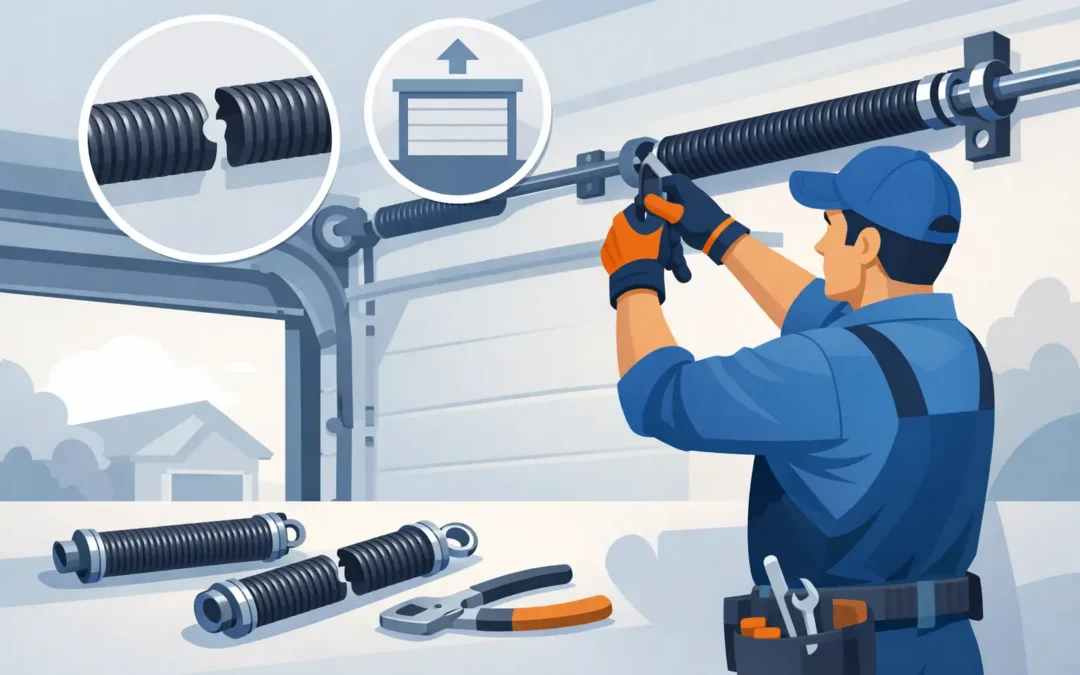
A garage door that suddenly feels too heavy, stops halfway, or slams shut is usually telling you the same thing – the spring system is failing. Garage door spring replacement is one of the most common major repairs homeowners face, and it is also one of the most important to handle correctly. Springs do the hard work of lifting and balancing the door. When they wear out, the entire system becomes harder on the opener, less predictable, and far less safe.
Why garage door spring replacement matters
Most people do not think about garage door springs until something goes wrong. That is understandable. Springs are tucked above the door or alongside the track, and when the door is working normally, they stay out of sight and out of mind.
The problem is that springs are under significant tension every time the door opens and closes. Over time, that stress adds up. A worn spring can make the door noisy, uneven, or slow to move. A broken spring can make the door inoperable or dangerous to use. In practical terms, replacing the spring at the right time protects the door, the opener, and the people using it.
For homeowners, that means fewer sudden breakdowns and less risk of damage to vehicles or property. For commercial properties, it can also mean avoiding downtime, access issues, and unnecessary disruption to daily operations.
Signs your springs may need replacement
Spring failure is not always dramatic. Sometimes there is a loud bang in the garage, and the door will not open afterward. Other times, the warning signs build gradually.
If the door feels unusually heavy when operated manually, that is a red flag. If it opens a few inches and stops, lifts unevenly, or closes faster than it should, the spring balance may be off. You may also notice gaps in a torsion spring, frayed cables, jerky movement, or strain on the opener.
In some cases, the opener still tries to do the work. That can create a second problem. Garage door openers are not designed to carry the full weight of the door by themselves. Continuing to run the opener with a failed spring can burn out the motor, damage components, or shorten the life of the system.
Torsion vs. extension springs
Not every garage door uses the same spring setup, and that affects how replacement is handled. Most modern residential doors use torsion springs mounted above the opening. These are designed to wind and unwind in a controlled way, providing smoother balance and more reliable performance.
Some older systems use extension springs mounted along the horizontal tracks. These stretch and contract as the door moves. They can still be effective, but they generally involve different hardware and often require closer inspection of safety cables and related components.
Commercial doors may use heavier-duty torsion systems sized for larger, more demanding applications. The spring selection has to match the door weight, cycle requirements, and usage pattern. A spring that is right for a residential door may be completely wrong for a commercial opening.
That is one reason this job is not one-size-fits-all. Correct spring replacement depends on the exact door size, weight, and application.
Why spring replacement is not a DIY repair
There are some garage door issues a handy property owner can safely address, such as replacing remote batteries or clearing debris from tracks. Spring work is different.
Garage door springs are tightly wound and store a large amount of force. If handled improperly, they can release that force suddenly. That can lead to serious injury and major property damage. Even if someone manages to remove and install a spring without incident, using the wrong size or setting the wrong tension can create balance problems that affect the entire door system.
A properly trained technician does more than swap out a broken part. They confirm the spring type, measure the door correctly, inspect cables and bearings, set the tension to the right level, and test door balance and safety operation before the job is complete. That level of precision matters.
What happens during garage door spring replacement
A professional garage door spring replacement usually starts with inspection. The technician identifies whether one spring has failed or whether both should be replaced, checks the condition of related hardware, and confirms the correct replacement specification.
From there, the damaged spring is removed with the proper tools and controlled procedures. The new spring or springs are installed, tensioned, and tested. If the system includes worn cables, drums, bearings, or center supports, those issues may be addressed at the same time.
After installation, the door should open smoothly, stay balanced, and move without excessive strain. The opener should also be tested to make sure it is operating within a safe range. A good service call leaves the whole system working properly, not just the spring.
Should you replace one spring or both?
This depends on the setup, but in many cases, replacing both springs is the smarter decision. On a two-spring system, both springs usually have the same age and cycle count. If one has failed, the other is often close behind.
Replacing only the broken spring may lower the immediate cost, but it can lead to another service call sooner than expected. Replacing both at once usually provides more even performance and helps restore proper balance across the system.
There are exceptions. If one spring was replaced recently and the other is still in strong condition, a technician may recommend replacing just the failed component. The right answer depends on age, wear, and system performance.
Cost factors homeowners and managers should understand
People often ask what garage door spring replacement costs, but there is no single price that fits every job. The final number depends on the spring type, the door size and weight, whether one or two springs are being replaced, and whether other worn components are discovered during inspection.
A heavier insulated door usually requires different springs than a lighter single door. Commercial applications can involve more specialized hardware and labor. Emergency service timing may also affect cost.
The better question is whether the repair is being done correctly with the right parts. Cheap, mismatched springs can create repeat failures, poor door balance, and avoidable damage to the opener. In most cases, quality parts and proper installation save money over time.
When repair is enough and when replacement makes more sense
If the issue is limited to a worn spring and the rest of the system is in good condition, spring replacement is usually the right repair. It restores function without requiring a full door replacement.
If the door is older, badly damaged, poorly balanced, or paired with outdated hardware, the conversation may be different. A technician may recommend broader repairs or a new door system if multiple components are near failure. That is especially true when the door has recurring issues or no longer meets the property’s performance needs.
For commercial customers, replacement decisions may also involve cycle demands, safety compliance, and downtime risk. A loading area or service bay that opens dozens of times each day needs hardware built for that level of use.
Choosing the right service provider for garage door spring replacement
Not every company approaches this work with the same level of care. Experience matters, especially with spring systems that require exact sizing and controlled installation. You want a provider that understands both residential and commercial applications, carries quality replacement parts, and can identify related issues before they become bigger problems.
Regional service matters too. A local company with a long track record is more likely to stand behind its work and respond quickly when service is needed. For customers across Northern Illinois and Southern Wisconsin, that practical reliability matters just as much as the repair itself.
Barcol Door Company has built its reputation on that kind of dependable service – experienced technicians, strong product knowledge, and repair support that solves the problem the right way.
How to help your new springs last longer
Springs eventually wear out, but proper maintenance can help the system perform better over time. Routine inspection catches frayed cables, worn rollers, and balance issues before they create bigger failures. Keeping the door properly aligned and the opener adjusted correctly also reduces stress on the spring system.
Usage matters as well. A garage door that opens and closes multiple times a day will naturally move through its cycle life faster than one used occasionally. That does not always mean a problem. It simply means the parts need to match how the door is actually used.
If your door has become noisy, uneven, or unreliable, waiting usually makes the repair more inconvenient and potentially more expensive. A failing spring rarely fixes itself. Getting it checked early is the simplest way to protect the door, the opener, and the people who depend on it every day.
When a garage door starts acting like dead weight, that is not the time for guesswork. The right spring replacement gets the door back to safe, dependable operation and lets you move on with confidence.