
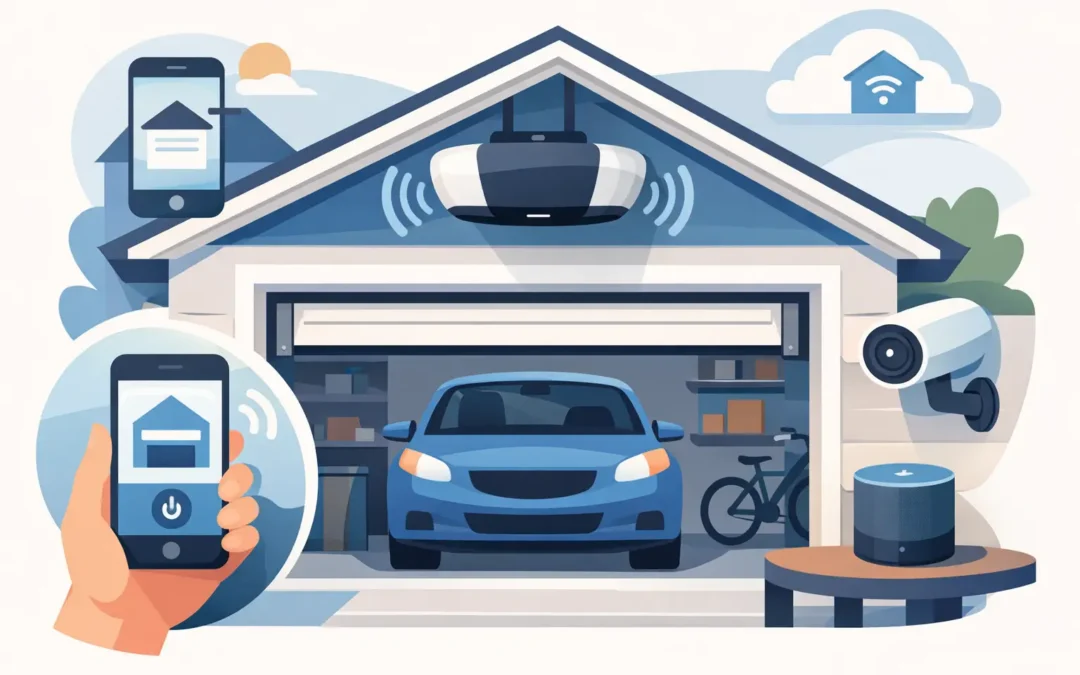
The garage is often the main way a family comes and goes, yet many homeowners still rely on a remote that disappears under a car seat or a wall button inside the garage. This smart garage opener review focuses on what makes connected access worthwhile, where the technology can fall short, and what should be checked before adding it to your home.
A smart opener can let you monitor, open, or close your garage door from a phone. Some systems build those controls into a new opener, while others add a Wi-Fi controller to an existing unit. The right choice depends less on the app’s appearance and more on compatibility, safety, daily use, and the condition of the door and opener already in place.
What a Smart Garage Opener Should Do Well
The core benefit is simple: you can confirm whether the door is open when you are away from home. For homeowners who leave for work early, manage kids’ schedules, accept deliveries, or travel often, that visibility can remove a common source of worry.
A dependable system should send an alert when the door opens or closes, show its current position accurately, and allow authorized users to operate it without handing out spare remotes. Most models also support scheduled closing, so the door can close automatically at a chosen time if it has been left open. That feature is useful, but it should be treated as a backup, not a substitute for checking that the doorway is clear.
Many smart openers work with voice assistants and home automation platforms. This can be convenient when your hands are full, but it is not the most important buying factor. A system that connects reliably, reports the door status correctly, and has a straightforward way to add or remove users is more valuable than one with a long list of integrations.
Smart Garage Opener Review: Built-In vs. Add-On Controls
Homeowners generally have two paths. The first is replacing the existing opener with a new smart model. The second is installing a smart controller that connects to a compatible existing opener.
A new smart opener is usually the better long-term solution when the current unit is noisy, unreliable, lacks battery backup, or is near the end of its service life. New models can offer quieter belt-drive operation, stronger lighting, better control panels, integrated cameras on select units, and modern security features. If a replacement is already needed, built-in smart control keeps the system simpler and avoids investing in an older machine.
An add-on controller can make sense when the existing opener is mechanically sound and has the necessary safety features. It is often a lower-cost way to gain app access and alerts. However, add-on products have compatibility limits. Some openers use proprietary control wiring, certain older models may not work properly, and a controller cannot correct a worn motor, failing gear, damaged photo eyes, or a poorly balanced door.
Before choosing either option, identify the opener’s brand, model number, age, and type of wall control. A quick compatibility check can prevent a purchase that will not install or will provide limited functionality.
Security Is More Than Opening the Door From a Phone
A connected garage door should improve security, not create extra exposure. Start with account protection. Use a unique, strong password for the opener app and turn on multi-factor authentication when it is available. Avoid sharing one main account with every family member. Instead, create individual user access so permissions can be removed when circumstances change.
Guest access is helpful for a dog walker, relative, contractor, or house sitter, especially when the app allows scheduled or temporary permissions. It is also safer than leaving a remote in an unlocked vehicle. Review guest access regularly, and remove it as soon as it is no longer needed.
The home Wi-Fi network matters too. Keep the router updated, use a secure network password, and do not connect garage controls to an unsecured guest network unless the manufacturer specifically supports that arrangement. If the system includes a camera, consider where it points and who can view recorded footage. Video can be useful for verifying activity, but it also deserves the same privacy attention as any other home camera.
Smart access does not replace basic garage security. Keep the emergency release protected from outside tampering, lock the door between the garage and house, and avoid storing visible valuables near windows. A connected opener is one part of a larger security plan.
Reliability Depends on the Door System, Not Just the App
A phone notification is only useful if the door operates safely and consistently. The garage door is the largest moving object in most homes, and its springs, cables, rollers, tracks, and safety sensors all affect how the opener performs.
If the door is heavy, jerks during travel, makes grinding noises, reverses unexpectedly, or will not stay open when disconnected from the opener, the problem needs professional attention. Adding a smart controller to a door with mechanical issues can mask the real concern for a while, but it will not fix it.
Photo-eye sensors near the bottom of the tracks are especially important. They must be aligned, clean, and functioning correctly so the door reverses when an obstruction is detected. Test the reversing system periodically according to the opener manufacturer’s instructions. Never bypass or disable safety sensors to make a door close.
Power outages are another practical consideration. Wi-Fi controls may be unavailable when the internet is down, and an opener will not run without power unless it has battery backup. In areas where storms can cause outages, battery backup is a feature worth prioritizing. It allows the door to operate for a limited time and keeps the garage usable when access matters most.
Features Worth Paying For
Not every smart feature earns its place. For most homeowners, the best value comes from reliable remote status, activity alerts, secure user controls, and battery backup. A bright integrated light can also make the garage safer and more useful, particularly when the garage serves as a daily entry point.
A camera-equipped opener may be a good fit for homeowners who want to see who enters the garage or verify deliveries. It is less necessary when the garage is detached, rarely used for entry, or already covered by an exterior security camera. Likewise, a quiet belt-drive opener is worth considering when there is a bedroom or living area above or beside the garage. A chain-drive unit may still be an economical choice for a detached garage where sound is less of a concern.
For a two- or three-car garage, think about how each door will be controlled. Separate openers usually require separate smart connections, though one app may manage all of them. Make sure the app clearly identifies each door. Closing the wrong door from across town is inconvenient at best and disruptive if someone is working in the garage.
Installation Is Where Convenience Meets Safety
Some add-on controllers are designed for homeowner installation, but a clean installation still requires the right wiring, a stable Wi-Fi signal, and correct placement of door-position sensors. New opener installation is more involved. It requires proper rail assembly, mounting, travel-limit adjustment, force settings, safety sensor alignment, and a complete operational test.
Professional installation is especially advisable when replacing an older opener, when the door needs repair, or when the garage has high ceilings, unusual framing, or electrical concerns. An experienced technician can assess whether the opener is appropriately sized for the door and whether the door is balanced before the new unit is put into service.
For homeowners in Northern Illinois and Southern Wisconsin, Barcol Door Company can help evaluate the complete system rather than treating the app as the only decision. That includes the door’s condition, opener performance, safety equipment, and the features that make sense for how the household actually uses the garage.
The Best Choice Is the One You Will Trust Every Day
A smart garage opener is a practical upgrade when it gives you dependable information and control without adding confusion. Choose a compatible product from an established manufacturer, protect the account, and do not overlook the condition of the door itself. The goal is not more technology in the garage. It is knowing that the door will open when you need it, close securely when you leave, and operate safely for everyone at home.